



希腊雅典大学Evangelismos医院神经外科的Christos Koutsarnakis等对眶额区通过逐步解剖研究,首次引入岛尖区作为有效区分钩束和枕额束干的关键表面标志,这一发现可能提高清醒皮层下定位的空间分辨力,尤其是对于岛叶病变,并提高体内弥散张量成像方案的准确性。该结果发表于2021年的《World Neurosurg》上。 ——摘自文章章节
The Topography of the Frontal Terminations of the Uncinate Fasciculus Revisited
Through Focused Fiber Dissections: Shedding Light on a Current Controversy and
Introducing the Insular Apex as a Key Anatomoclinical Area
Faidon Liakos1,4 , Spyridon Komaitis1,2,4 , Evangelos Drosos1,2 , Eleftherios Neromyliotis1,2,5 , Georgios P. Skandalakis1 , Apostolos I. Gerogiannis1 , Aristotelis V. Kalyvas1,2,4 , Theodore Troupis1,4 , George Stranjalis1,2,5 , Christos Koutsarnakis1-5
通过关注纤维解剖来重新审视钩束额端的地形图:阐明当前争议并引入岛尖作为临床解剖的关键区域
To whom correspondence should be addressed: Christos Koutsarnakis, M.D., M.Sc.
[E-mail: ckouts@hotmail.co.uk]
Faidon Liakos and Christos Koutsarnakis equally contributed to this study.
Citation: World Neurosurg. (2021).
https://doi.org/10.1016/j.wneu.2021.06.012
Journal homepage: www.journals.elsevier.com/world-neurosurgery
Available online: www.sciencedirect.com
背景
BACKGROUND: Recent studies advocate a connectivity pattern wider than previously believed of the uncinate fasciculus that extends to the ventrolateral and dorsolateral prefrontal cortices. These new percepts on the connectivity of the tract suggest a more expansive role for the uncinate fasciculus. Our aim was to shed light on this controversy through fiber dissections.
背景:以前认为钩束延伸到前额叶皮层的腹外侧和背外侧,最近的研究提倡其连通模式更广泛。这些对束连通的知觉表明钩束的作用更广泛。我们的目的是通过纤维解剖来阐明这一争议。
方法
METHODS: Twenty normal adult human formalin-fixed cerebral
hemispheres were used. Focused dissections on the insular, orbitofrontal, ventromedial, ventrolateral, and dorsolateral prefrontal areas were performed to record the topography of the frontal terminations of the uncinate fasciculus.
方法:采用经福尔马林固定的20例正常成人大脑半球。关注岛叶,完成对前额叶的眶额、腹内侧、腹外侧和背外侧区的解剖并记录钩束额端的地形图。
结果
RESULTS: Three discrete fiber layers were consistently disclosed: the first layer was recorded to terminate at the posterior orbital gyrus and pars orbitalis, the second layer at the posterior two thirds of the gyrus rectus, and the last layer at the posterior one third of the paraolfactory gyrus. The insular apex was documented as a crucial landmark regarding the topographic differentiation of the uncinate and occipitofrontal fasciculi (i.e., fibers that travel ventrally belong to the uncinate fasciculus whereas those traveling dorsally are occipitofrontal fibers).
结果:一致地揭示了三个不相连的纤维层:第一层终止于眶后回和眶部,第二层终止于直回的后2/3,最后一层终止于嗅旁回后1/3。证实岛尖为钩束和枕额束地形分化的重要标志(也就是向腹侧走形的纤维属于钩束,而向背侧的是枕额纤维)。
结论
CONCLUSIONS: The frontal terminations of the uncinate fasciculus were consistently documented to project to the posterior orbitofrontal area. The area of the insular apex is introduced for the first time as a crucial surface landmark to effectively distinguish the stems of the uncinate and occipitofrontal fasciculi. This finding could refine the spatial resolution of awake subcortical mapping, especially for insular lesions, and improve the accuracy of in vivo diffusion tensor imaging protocols.
结论:一致证实钩束额端投射至眶额区后部。首次引入岛尖区作为有效区分钩束和枕额束干的关键表面标志。这一发现可提高清醒皮层下定位的空间分辨力,尤其是对于岛叶病变,并提高体内弥散张量成像方案的准确性。

Figure 1. (A) Lateral aspect of a left hemisphere. The regional surface anatomy is shown. Inferolateral view of a left hemisphere. The surface anatomy of the orbitofrontal area is shown. The cruciform sulcus divides the basal frontal area into 4 orbital gyri. (B-D) Variations of the insular surface anatomy. Lateral aspect of 3 left hemispheres. The cortex of the orbital surface, inferior frontal gyrus, part of the middle frontal gyrus, and anterior temporal lobe has been removed and the short arcuate fibers become apparent. In (C) and (D) the temporal pole has also been removed for better access to the insular and orbitofrontal areas. The morphologic variation of the surface anatomy of the insula is shown particularly regarding the area of the insular apex.
Green disk, insular apex; blue disk, limen insula. Alig,anterior long insular gyrus; AO, anterior orbital gyrus; Asig, anterior short insula gyrus; ITG, inferior temporal gyrus. LO, lateral orbital gyrus; MFG,middle frontal gyrus; MO, medial orbital gyrus; Msig, middle short insular gyrus; MTG, middle temporal gyrus; Plig, posterior long insular gyrus; PO,posterior orbital gyrus; Psig, posterior short insular gyrus; PsO, pars orbitalis; PsT, pars triangularis; RS, sulcus of Rolando; STG, superior temporal gyrus.
图1(A)左侧半球的外侧面。图示局部表面解剖结构。左侧半球的下外侧面视图。图示眶额区的表面解剖结构。十字形沟将额底区分为4个眶回。(B-D)岛叶表面解剖的变异。3个左侧半球的外侧面。切除眶面、额下回、部分额中回和颞前叶的皮层,显现短弓状纤维。在(C)和(D)中,颞极也被移除,以更好地进入岛叶和眶额区。岛叶表面解剖结构的形态学变异尤其表现在岛尖区。
绿色盘区,岛尖;蓝色盘区,岛阈。Alig,前长岛回;AO,眶前回;Asig,前短岛回;ITG,颞下回。LO,眶外侧回;MFG,额中回;MO,眶内侧回;Msig,中短岛回;MTG,颞中回;Plig,后长岛回;PO,眶后回;Psig,后短岛回;PsO,眶部;PsT,三角部;RS,Rolando沟;STG,颞上回。
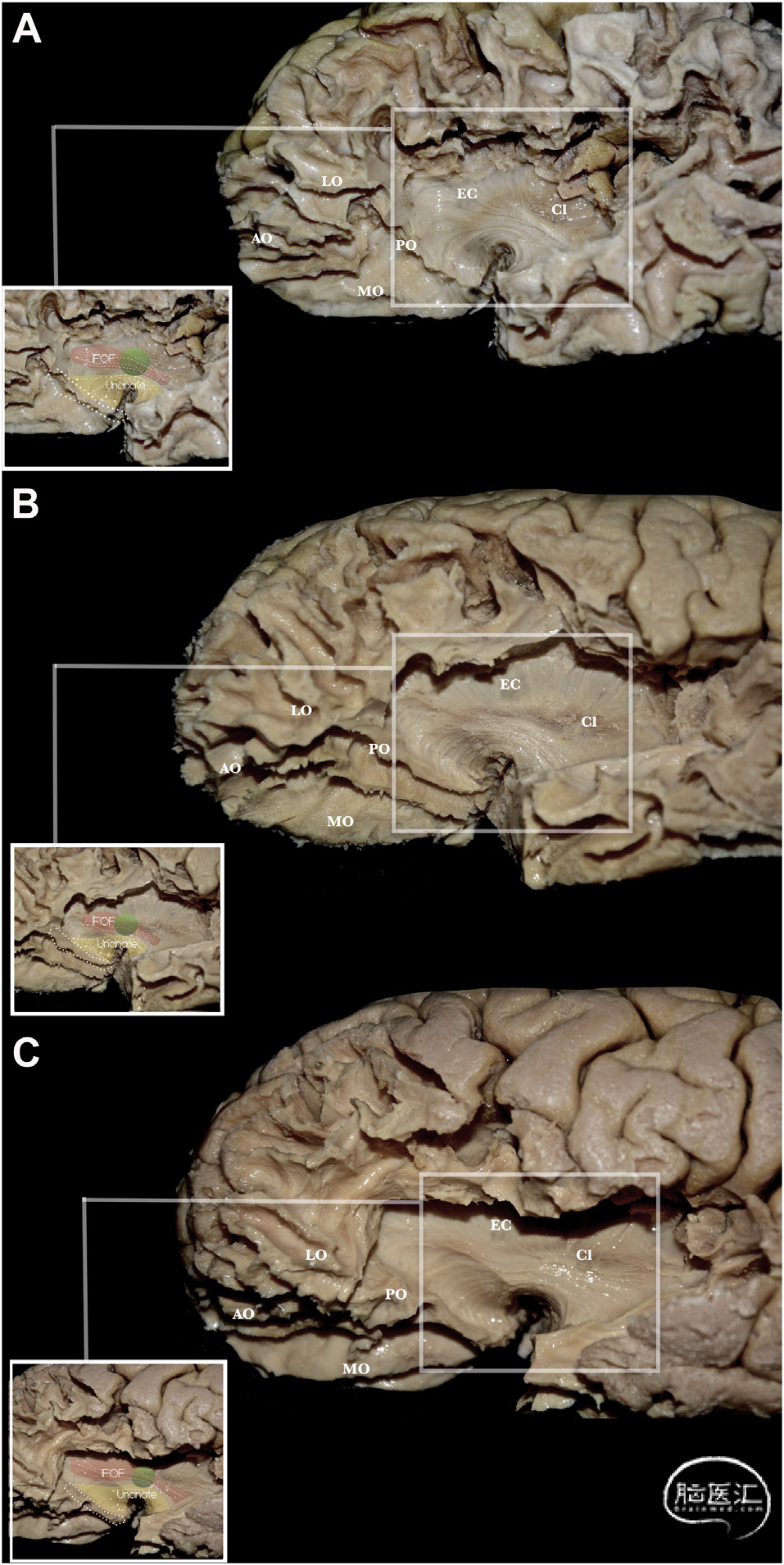
Figure 2. (A-C) The same specimens and same views as in Figure 1. The first fiber layer of the uncinate fasciculus is shown. The insular apex is introduced as a surface landmark for differentiating the uncinate from the occipitofrontal fasciculus. Progressive dissection of the short arcuate fibers of the anterior insular and orbitofrontal areas shows the first layer of fibers of the uncinate fasciculus (yellow bundle), which are followed and seen to terminate at the posterior orbital gyrus and pars orbitalis (dotted area). Fibers proved to belong to the occipitofrontal fasciculus (magnified area with the red bundle) are also evident, traveling close to the uncinate fasciculus. The area of the insular apex is marked with a green disk. Note that in all cases, fibers that travel just under and dorsal to the area of the insular apex are occipitofrontal fibers, whereas those that lie ventrally to the insular apex belong to the uncinate fasciculus.
Yellow bundle, trajectory of the first layer of the uncinate fasciculus; red bundle, trajectory of the occipitofrontal fasciculus; green disk, insular apex. AO, anterior orbital gyrus; Cl, claustrum; EC, external capsule; IFOF, inferior fronto-occipital fascicle; LO, lateral orbit gyrus; MO, medial orbital gyrus; PO, posterior orbital gyrus.
图2(A-C)与图1相同的标本和视图。图示钩束的第一层纤维。引入岛尖作为区分钩束和枕额束的表面标志。对前岛回和眶额区的短弓状纤维进行逐步解剖显示钩束的第一层纤维(黄色束),随后观察到其终止于眶后回和眶部(虚线区)。证明属于枕额束(放大的红色束区)的纤维也很明显,靠近钩束走行。岛尖区以一绿色盘区标记。请注意,在所有情况下,正好在岛尖下方和其背侧走行的纤维是枕额纤维,而位于岛尖腹侧的纤维属于钩束。
黄色束,钩束第一层的轨迹;红色束,枕额束的轨迹;绿色盘区,岛尖。AO,眶前回;Cl,屏状核;EC,外囊;IFOF,下额枕束;LO,眶外侧回;MO,眶内侧回;PO,眶后回。
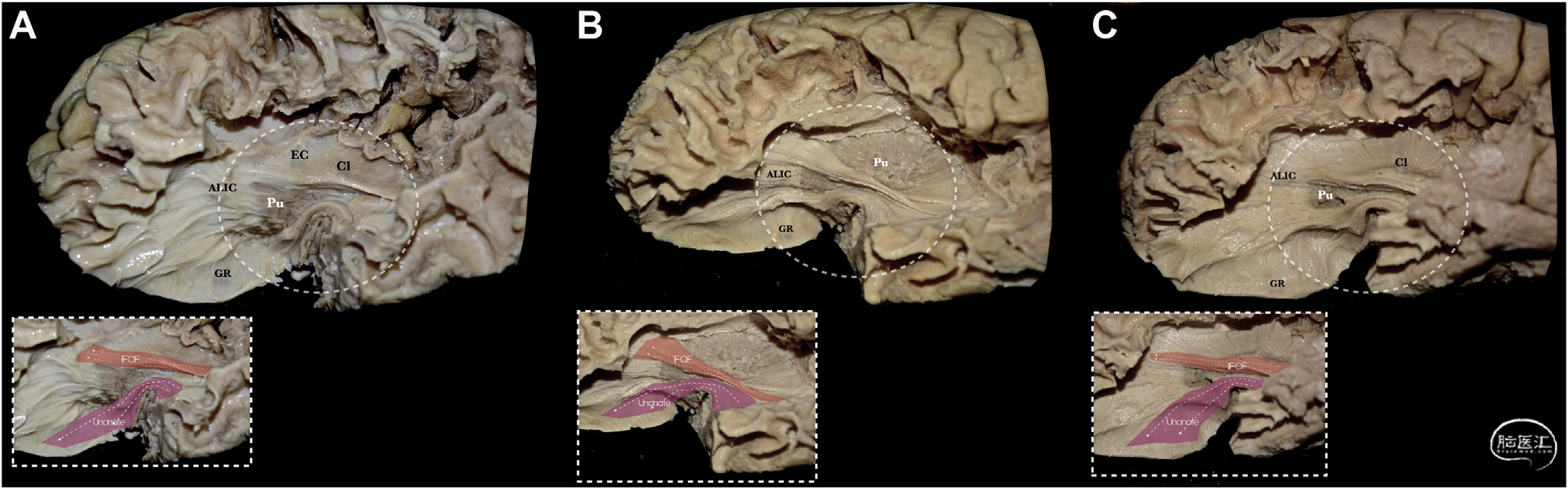
Figure 3. (A-C) Same specimens and same views as in Figure 2, showing the second layer of the uncinate fasciculus. Progressive dissection shows the second layer of uncinate fibers radiating to the posterior two thirds of the gyrus rectus. At this stage, a clear cleavage plane between the stems of the uncinate and inferior occipitofrontal fasciculi can be developed. Between these 2 fiber pathways, the plane of dissection deepens so as to show the ventral surface of the putamen centrally and the lateral part of the anterior limb of the internal capsule at the periphery.
Pink bundle, trajectory of the second layer of the uncinate fasciculus;, orange bundle, trajectory of the occipitofrontal fasciculus. ALIC, anterior limb of the internal capsule; Cl,claustrum; EC, external capsule; GR, gyrus rectus; IFOF, inferior fronto-occipital fascicle; Pu, putamen.
图3(A-C)与图2相同的标本和视图,显示钩束的第二层。逐步解剖显示第二层钩状纤维辐射至直回后2/3。在这个阶段,钩束和下枕额束的干之间可形成一清晰的劈裂面。在这两条纤维通路之间,解剖平面加深,从而在中央显示壳核的腹侧面,在边缘显示内囊前肢的外侧部分。
粉红色束,钩束第二层的轨迹;,橙色束,枕额束的轨迹。ALIC,内囊前肢;Cl,屏状核;EC,外囊;GR,直回;IFOF,下额枕束;Pu, 壳核。
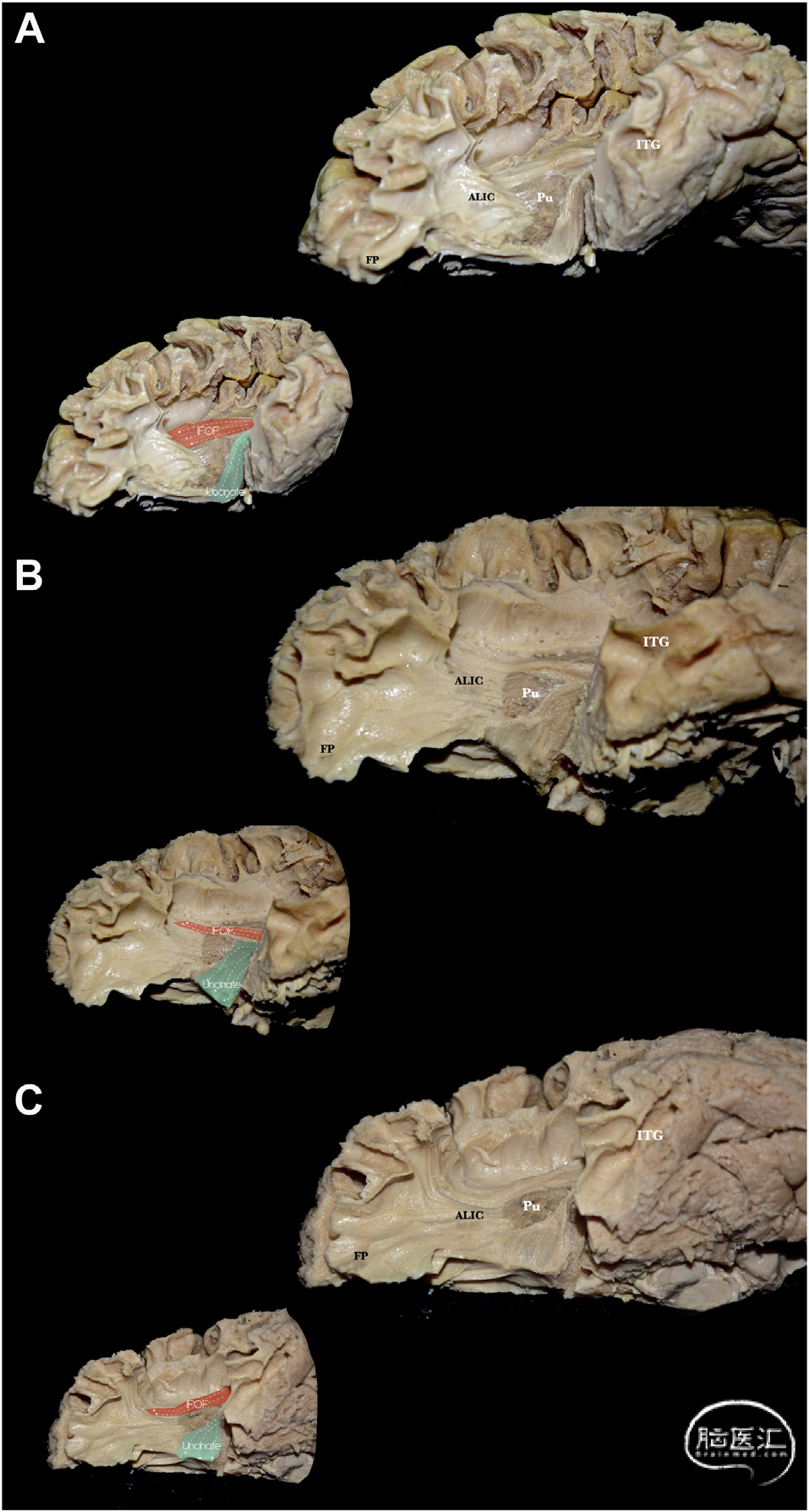
Figure 4. (A-C) Inferior views of the same specimens as in Figure 2, exposing the third layer of fibers of the uncinate fasciculus. Progressive dissection exposes the third layer of uncinate fibers seen to radiate toward the medial surface of the hemisphere. These fibers are exposed and their termination pattern shown in Figure 5.
Aqua bundle, trajectory of the third layer of uncinate fibers; red bundle, trajectory of the occipitofrontal fasciculus. ALIC, anterior limb of the internal capsule; FP, frontal pole;IFOF, inferior fronto-occipital fascicle; ITG, inferior temporal gyrus; Pu,putamen.
图4(A-C)图2中相同标本的下视图,暴露钩束的第三层纤维。逐步解剖暴露出第三层钩状纤维,可见其向半球内侧面辐射。暴露这些纤维及其终止方式如图5所见。
湖绿色束,第三层钩状纤维的轨迹;红色束,枕额束的轨迹。ALIC,内囊前肢;FP,额极;IFOF, 下额枕束;ITG,颞下回;Pu, 壳核。
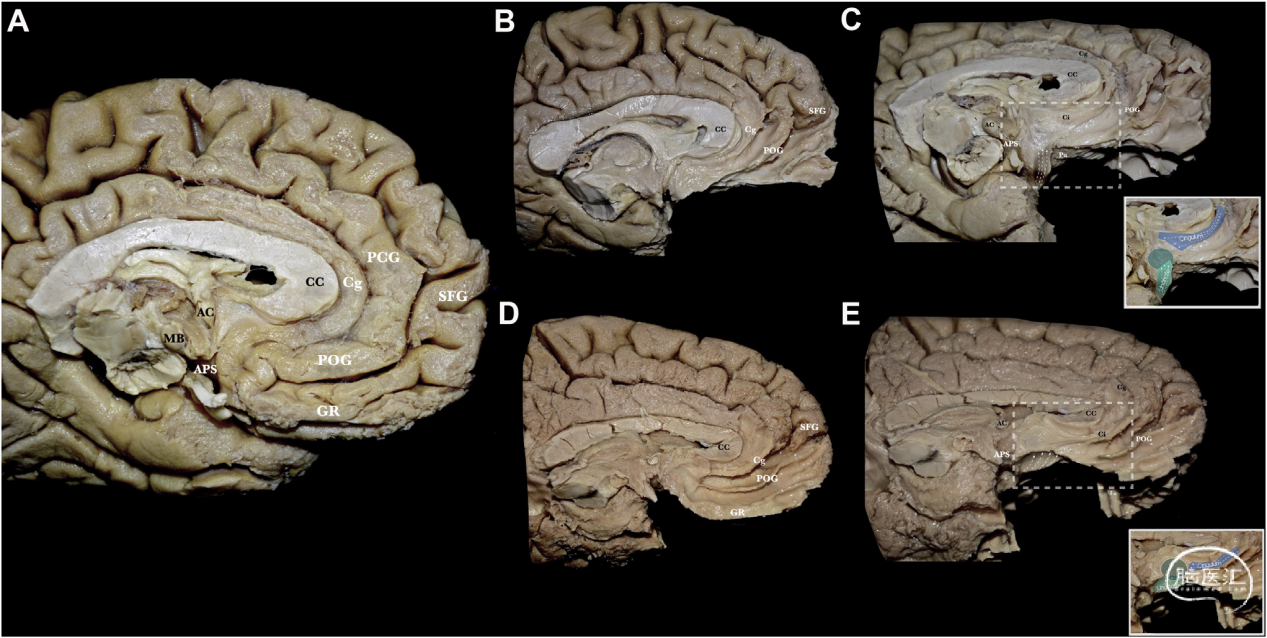
Figure 5. Medial view of a left hemisphere. (A) The regional surface anatomy is shown. The paracingulate gyrus continues ventrally as the paraolfactory gyrus. The gyrus rectus continues as the superior medial frontal gyrus. The mammillary body, the anterior commissure, and the anterior perforated substance are also shown. (B and C) Exposing the short arcuate fibers. Medial views of 2 left hemispheres. On removing the cortex of paraolfactory gyrus, gyrus rectus, and cingulate gyrus, the short arcuate U fibers connecting adjacent gyri are exposed. (D and E) Medial aspect of the third layer of the uncinate fasciculus. Inferomedial views of the specimens in Figure 5B and C. Progressive fiber dissection shows the fibers of the third layer of the uncinate fasciculus (green bundle in the magnified area) that are followed to their lateral extension. These fibers are documented to terminate at the posterior paraolfactory gyrus (green disk in the magnified area) close to the ventral end of the cingulum (deep blue bundle).
Green bundle, trajectory of the third layer of the uncinate fasciculus; green disk, posterior end of the paraolfactory gyrus; deep blue bundle, cingulum. AC, anterior commissure; APS, anterior perforated substance; CC, corpus callosum; CG, cingulate gyrus; GR, gyrus rectus;MB, mammillary body; PCG, paracingulate gyrus; POG, paraolfactory gyrus;SFG, superior frontal gyrus.
图5左侧半球内侧视图。(A)图示了局部表面解剖结构。扣带旁回在腹侧延续为嗅旁回。直回延续为额上内侧回。还显示了乳头体、前连合和前穿孔物质。(B和C)暴露短弓状纤维。两个左侧半球的内侧视图。一去除嗅旁回、直回和扣带回,就暴露出连接相邻脑回的U形短弓状纤维。(D和E)钩束第三层的内侧面。图5B和C中标本的下内侧视图。逐步解剖纤维显示钩束的第三层纤维(放大区中的绿色束),其随后向外侧延伸。证实这些纤维终止于邻近扣带(深蓝色束)腹侧端的嗅旁回后部(放大区的绿色盘区)。
绿色束,钩束第三层的轨迹;绿色盘区,嗅旁回后端;深蓝色束,扣带。AC,前连合;APS,前穿质;CC,胼胝体;CG,扣带回;GR,直回;MB,乳头体;PCG,扣带旁回;POG,嗅旁回;SFG,额上回。
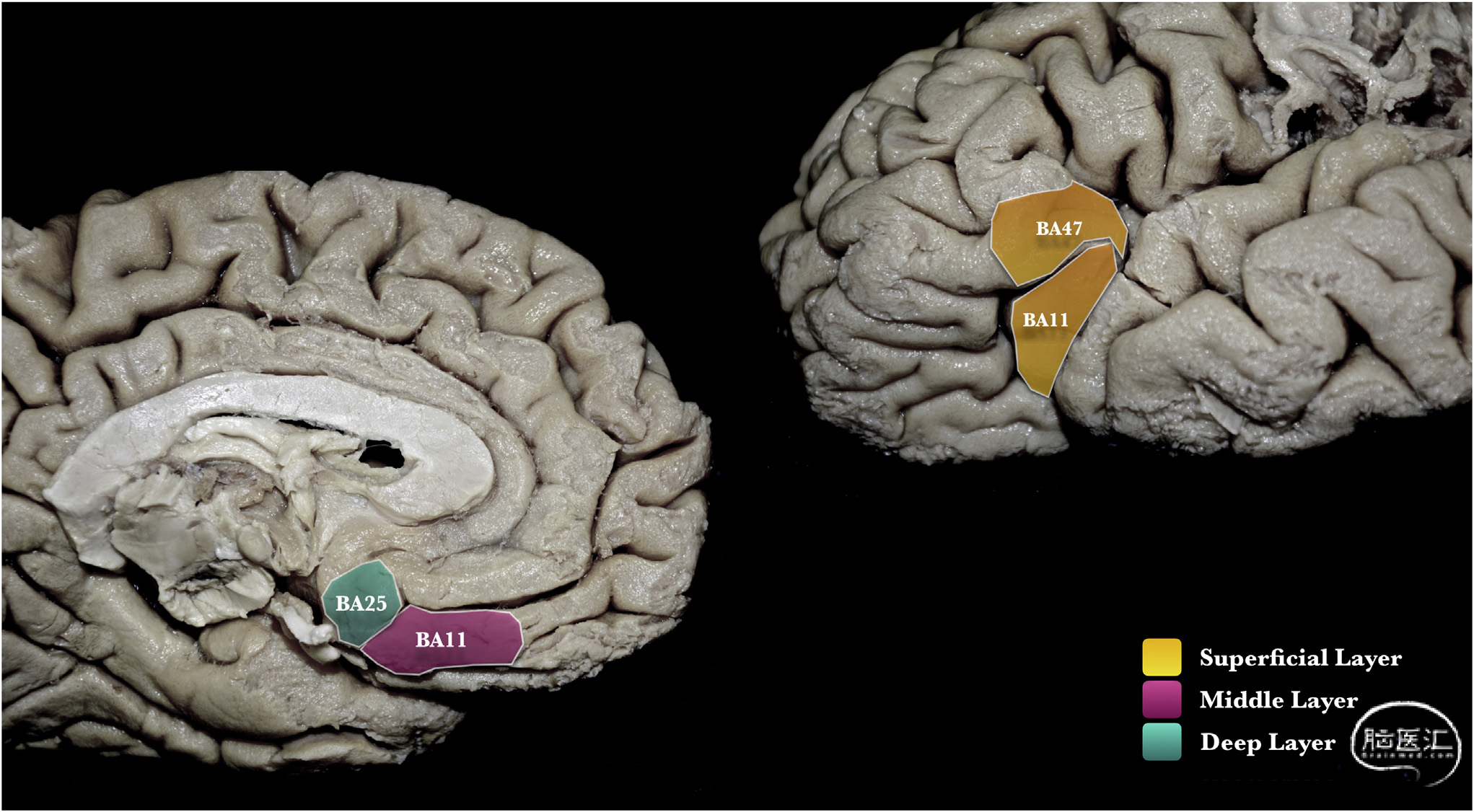
Figure 6. The termination areas of uncinate fasciculus projected in the surface anatomy of the frontal lobe. The lateral and medial aspects of the same specimen are shown. The first layer projects in the posterior orbital gyrus and the adjacent segment of the pars orbitalis (Brodmann areas 11 [BA11] and 47 [BA47]). The second layer terminates at the gyrus rectus (Brodmann area 11) and the third layer ends at the posterior third of the paraolfactory gyrus (Brodmann area 25 [BA25]).
Yellow area, first layer; pink area, second layer; green area, third layer.
图6. 钩束的终止区投射于额叶的表面解剖结构中。图示了同一标本的外侧面和内侧面。第一层投射于眶后回和眶部的相邻节段(Brodmann 11区[BA11]和47区[BA47])。第二层终止于直回(Brodmann 11区),第三层终止于嗅旁回的后1/3(Brodmann 25区[BA25])。
黄色区,第一层;粉红色区,第二层;绿色区,第三层。
译者简介

张卫民
主任医师
湖南省脑科医院(湖南省第二人民医院)
神经外科一病区,曾先后至美国Mayo Clinic及UCLA、德国
University Medicine Griefswald神经外科中心访问学习
神经疾病、解剖及手术翻译爱好者
严于术前 精于术中 勤于术后
相识是缘
声明:脑医汇旗下神外资讯、神介资讯、神内资讯、脑医咨询、Ai Brain 所发表内容之知识产权为脑医汇及主办方、原作者等相关权利人所有。