



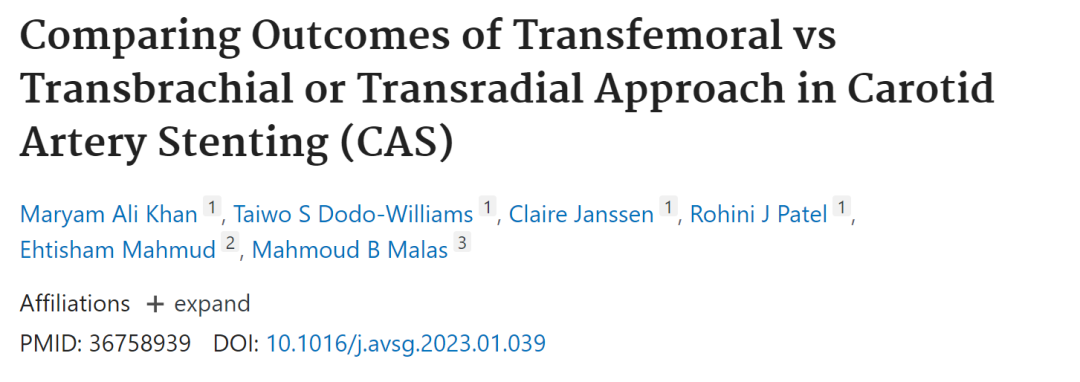

摘要
简介:对于可能适合CEA或TCAR的患者,经股动脉支架置入术(TFCAS)是一种有效的微创选择,但只有当解剖因素排除了颈动脉或股动脉直接入路时,才会使用经臂动脉(TB)或经桡动脉(TR)等其他入路。
在这项研究中,我们的目的是评估TR/TB通路与TF经皮颈动脉血运重建的结果。
方法
纳入2012年1月至2021年6月血管质量倡议(VQI)数据库中所有接受非tcar CAS的患者。
患者根据CAS的进入部位分为两组:TF组或TR/TB组。
主要结局包括中风/死亡、技术失败和通路部位并发症(血肿、狭窄、感染、假性动脉瘤和房室瘘)。
次要结局包括卒中、TIA、MI、死亡、非在家出院、术后延长住院时间(> 1天),以及卒中/MI和卒中/死亡/MI的复合终点。
采用单变量和多变量logistic回归模型评估术后结果,并对相关潜在混杂因素进行调整,包括年龄、性别、种族、狭窄程度、症状状态、麻醉、合并症和术前用药。
结果
在23965例患者中,使用TR/TB入路的有819例(3.4%),使用TF入路的有23146例(96.6%)。
基线特征发现男性更有可能采用TR/TB方法进行血运重建(69.4% vs 64.9%, p=0.009)。
接受TR/TB入路的患者有更多症状性的(49.9% vs 28.6%, p<0.001)。
指导药物更常用于TR/TB,包括P2Y12抑制剂(80.3% vs 74.7%, p<0.01)、他汀类药物(83.8% vs 80.6%)和阿司匹林(88.3% vs 84.5%, p=0.003)。
单因素分析显示,采用TB/TR方法的患者不良结局发生率较高。
在对潜在混杂因素进行校正后,TR/TB患者卒中/死亡风险无显著增加[aOR 1.10(0.69-1.76), p=0.675];
然而,使用TR/TB与院内心肌梗死风险增加2倍以上相关[aOR 2.39(1.32-4.30), p=0.004]和技术失败风险增加2倍[aOR 2.21(1.31-3.73) p=0.003]。
使用TR/TB通道还与穿刺部位并发症风险降低50%相关[aOR 0.53(0.32-0.85), p=0.009]。
结论
本研究证实,尽管技术上更具挑战性,但TR或TB入路对于CAS是一种合理的替代方案,且可降低介入穿刺部位并发症,特别是在解剖因素排除TFCAS或TCAR行血运重建的患者中。
然而,TR/TB与技术失败和心肌梗死风险增加相关,这需要进一步研究。
Abstract
Introduction: While Transfemoral Carotid Artery Stenting (TFCAS) is a valid minimally invasive option for patients who also might be suitable for CEA or TCAR, alternative access sites such as transbrachial (TB) or transradial (TR) are only utilized when anatomic factors preclude direct carotid or transfemoral access. In this study, we aimed to evaluate the outcomes of TR/TB access in comparison to TF for percutaneous carotid artery revascularization.
Methods: All patients undergoing non-TCAR CAS from January 2012 to June 2021 in the Vascular Quality Initiative (VQI) Database were included. Patients were divided into two groups based on the access site for CAS: TF or TR/TB. Primary outcomes included stroke/death, technical failure and access site complications (hematoma, stenosis, infection, pseudoaneurysm and AV fistula). Secondary outcomes included stroke, TIA, MI, death, non-home discharge, extended length of postoperative stay (LOS) (> 1 day), and composite endpoints of stroke/MI and stroke/death/MI. Univariable and multivariable logistic regression models were used to assess postoperative outcomes, and results were adjusted for relevant potential confounders including age, gender, race, degree of stenosis, symptomatic status, anesthesia, comorbidities, and pre-operative medications.
Results: Out of the 23,965 patients, TR/TB approach was employed in 819(3.4%) while TF was used in 23,146(96.6%). Baseline characteristics found men were more likely to undergo revascularization using TR/TB approach (69.4% vs 64.9%, p=0.009). Patients undergoing TR/TB approach were also more likely to be symptomatic (49.9% vs 28.6%, p<0.001). Guideline directed medications were more frequently used with TR/TB including P2Y12 inhibitor (80.3% vs 74.7%, p<0.01), statin (83.8% vs 80.6%), and aspirin (88.3% vs 84.5%, p=0.003) preoperatively. On univariate analysis, patients with TB/TR approach experienced higher rates of adverse outcomes. After adjusting for potential confounders, TR/TB patients had no significant increase in the risk of stroke/death [aOR 1.10(0.69-1.76), p=0.675]; however, the use of TR/TB access was associated with a more than 2-fold increase in risk for in-hospital MI [aOR 2.39(1.32-4.30), p=0.004] and 2-fold increase in risk of technical failure [aOR 2.21(1.31-3.73) p=0.003]. The use of TR/TB access was also associated with a 50% reduction in the risk of access site complications [aOR 0.53(0.32-0.85), p=0.009].
Conclusion: This study confirms that although technically more challenging, TR or TB approach serves as a reasonable alternative with lower access site complications for CAS particularly in patients where anatomic factors preclude revascularization by TFCAS or TCAR. However, TR/TB is associated with an increased risk of technical failure and myocardial infarction, which requires further study.
Keywords: Carotid Artery Stenting; Transbrachial; Transfemoral; Transradial.

更多精彩内容 请关注作者

点击或扫描上方二维码
查看更多“介入”内容