



6.1引言
立体定向放射外科(SRS)的技术方面与常规的颅内放射治疗有很大的不同。常规颅内放疗涉及对包括正常组织和异常组织的大体积的组织照射。照射许多次(通常20-30次)小剂量(约2-3Gy),每次治疗分割之间有休息期(通常1-3天)[Traditional intracranial radiation involves the irradiation of large volumes of tissue, including both normal and abnormal tissue. A large number (often 20–30) of small doses (∼2–3 Gy) are given, with a rest period (usually 1–3 days) in between each treatment fraction.]。
治疗取决于正常和病理组织的修复电离辐射引起的DNA损伤得能力差异。相比之下,SRS对差异修复依赖较少,更多取决于靶向治疗效果的差异(The treatment relies on the differential ability of normal and pathological tissue to repair DNA damage induced by the ionizing radiation . In contrast, SRS relies less on differential repair and more on differential targeting for its treatment effect.)。
大剂量的辐射,以一次到最多五次分割的方式传递,理想情况下只针对靶病理组织。在理想的情况下,周围的正常组织接收到的剂量可以忽略不计,但实际上SRS治疗并没有完全达到这个理想的目标。最终实现的杀灭肿瘤的效果可能是由于DNA损伤以及只有在阈值得到吸收后才发生的生物效应(The resulting realized tumoricidal efficacy is likely due to both DNA damage as well as biological effects that occur only after a threshold has been absorbed)。
常规放射肿瘤学和SRS/立体定向放射治疗(SRT)在需求上的差异导致对后者的专门设备和程序的开发。本章讨论了SRS/SRT的技术基础,包括物理、固定技术、治疗计划、图像引导、质量保证和认证。本章特别强调了为响应SRS的特定技术需求而开发的特性(This chapter places special emphasis on the features that developed as a response to the specific technical demands of SRS)。
6.2 SRS的基本物理原理
SRS依靠三个基本原则来实现差异化靶向目标(to achieve its goal of differential targeting);(1)通过将辐射剂量扩散到较大的表面积而产生高剂量梯度(generation of high dose gradients by spreading out the radiation dose over a large surface area);(2)准确和精确的靶区定位(generation of high dose gradients by spreading out the radiation dose over a large surface area);(3)用高剂量照射小野(the delivery of small fields to high doses)。
6.2.1产生高剂量的梯度
SRS装置,无论其形式如何,都遵循类似的指导原则,以创建放疗所需的陡峭剂量梯度;它们各自将传递给靶区的总能量分散到一个广阔的表面区域( in order to create the steep dose gradients required by radiosurgery; they each spread the total energy delivered to the target out over a wide surface area)。
在伽玛刀放射外科中,是通过使用许多(201个或192个)广泛分布的射线束来实现的,它们都是被准直的,所以它们相交于一个焦点。射波刀放射外科也利用许多广泛分布的射线束在靶组织处交叉(尽管并不总是有明显的焦点)。基于直线加速器(LINAC)的放射外科或相对大量的非共面调强野,要么利用一系列非共面弧在靶组织内以等中心相交于一点[Linear accelerator (linac)-based radiosurgery makes use of either a relatively large number of non-coplanar modulated fields or a series of non-coplanar arcs that intersect isocentrically at a point within the targeted tissue]。野本身可以使用小的圆锥或微多叶准直器(MLCs)来塑形[The fields themselves may be shaped using small circular cones, or micro-multileaf collimators (MLCs)]。后者对于每个野可能是静态的,或者在拉弧的情况下可以在拉弧的整个过程中调节和/或适形(容积调强拉弧治疗[VMAT])[The latter of which may be static for each field, or in the case of arcs may modulate and/or conform over the course of the arc (volume-modulated arc therapy [VMAT]) ]。因为入射的光子在进入病人体内时分布很广,所以每束射线的强度相对较低,对远离焦点的正常组织造成的损伤也很小(Because the incoming photons are widely distributed as they enter the patient, the intensity of each individual radiation beam is relatively low and causes minimal damage to normal tissue distant from the focus point. )。然而,在靶区的所有射线束的总强度是相当高的。大的空间分布实现远离靶区的非常陡峭的梯度。因为质子(和其他带电粒子)射线束的特点是能够在与靶区相匹配的可预测深度上提供大部分能量,质子束放射外科比基于光子的放射外科需要较少的单束射线,但理论上能够同样地将剂量集中在靶区组织上[ Proton-beam radiosurgery requires fewer individual beams than photon-based radiosurgery, but is theoretically able to similarly concentrate dose on the targeted tissue because of the characteristic ability of proton (and other charged particle) beams to deliver the majority of their energy at a predictable depth that can be matched to that of the target]。
6.2.2 准确和精确定位
大量射线束或弧线瞄准三维(3D)空间的一个小点的能力以及其本身并不足以应付放射外科[The ability to aim large numbers of beams or arcs at a small point in three-dimensional (3D) space is not in and of itself sufficient for radiosurgery.]。为了发挥作用,在整个治疗过程中,空间中的小点必须尽可能准确地与靶组织重合(To be useful, that small point in space has to coincide with the targeted tissue as accurately and precisely as possible throughout the course of treatment.)。在SRS治疗中,这是通过结合现代3D成像技术来实现的,它允许对靶区和周围组织的可视化,定义靶组织和治疗设备之间的3D空间关系的方法,以及在治疗过程中防止靶组织移动出治疗射线束的固定方法(In SRS, this is achieved through a combination of modern 3D-imaging techniques to permit visualization of the target and surrounding tissue, methods to define the 3D spatial relationships between the targeted tissue and the treatment device, and methods for immobilization to prevent the targeted tissue from moving out of the treatment beams during the procedure)。
6.2.3小野,高剂量
先前的原理是将能量扩散开来,精确和准确的定位,然后允许最终原理;向小体积的组织传递高剂量的辐射( The prior principles spreading out the energy, and precise and accurate localization then permit the final principle; delivering high doses of radiation to small volumes of tissue. )。在放射肿瘤学的广泛范围内,放射外科的靶区一般都很小,其硬极限各不相同,但一个很好的标准是,靶区的最大直径应小于40毫米(Radiosurgical targets are generally quite small in the broad scope of radiation oncology hard limits vary, but a good rule of thumb is that targets should be less than 40 mm in largest diameter.)。对比这更大的靶区进行高剂量治疗会增加不良治疗结果的风险(Targets larger than this treated to high doses increase the risk of adverse treatment outcomes.)。剂量也相当大,通常在靶区范围内的最大点剂量范围为10-150Gy,而80-150Gy的最大剂量通常针对的是接受功能性毁损的患者( Doses are also quite large, typically in the range of 10-150 Gy point-dose maximum within the target with the largest doses of 80 150 Gy usually reserved for functional lesioning cases) 。
6.2.4立体定向放射外科的技术挑战
开发能够实现上述目标的技术解决方案是一项艰巨的任务,SRS/SRT方面的大部分开发都在改进中,以帮助实现目标。准确地将靶组织放置在射线束的交叉处给成像、定位和固定带来了挑战。准确计算小野的受照剂量,这与深入研究的参考标准不同,给辐射计量学和剂量学的建模带来了挑战(Accurately placing the targeted tissue at the intersection of the beams creates challenges for imaging, localization, and immobilization. Accurately computing dose to small fields, which depart from well-investigated reference standards, creates challenges for radiation metrology and dosimetric modeling.)。在本章的剩余部分,我们将描述放射外科技术如何解决这些问题。
6.3固定技术
6.3.1头架
放射外科直接从立体定向神经外科的实践发展而来,立体定向神经外科包括将外部机械框架系统固定在患者头部,以固定和创建一个坐标系统,使神经外科医生能够始终靶向大脑的任何想要的点(Radiosurgery evolved directly from the practice of stereotactic neurosurgery, which involved the fixation of an external mechanical frame system to a patient’s head both to immobilize and create a coordinate system, allowing neurosurgeons to consistently target any desired point in the brain. )。放射外科用聚敛电离射线束的焦点取代了物理神经外科仪器;然而,对固定和定位的要求仍然相似(Radiosurgery replaced physical neurosurgery instruments with a focal point of converging ionizing beams; however, the requirements for immobilization and localization remained similar.)。
一些框架已经并继续在放射外科中使用,包括Leksell G型框架[4],Gill-Thomas-Cosman (GTC)框架和Brown-Roberts-Wells (BRW)框架。虽然根据设计细节略有不同,但每个框架的基本原理是相似的。框架定义了一个靶区坐标系统,它包含靶区的体积和周围的组织(通常是整个头部)。使用框架和相关的外部基准对患者进行成像,这些基准在该主体图像坐标系和框架坐标系之间创建坐标转换(The patient is imaged with the frame and associated external fiducials, which create a coordinate transformation between the native image coordinate system and the frame coordinate system.)。框架刚性地安装在治疗床上,从而在框架坐标和照射机器坐标之间创建了固定的转换。
立体定向框架的优点是其机械稳定性、准确和相对简洁性(their mechanical stability, accuracy, and their relative simplicity)。然而,立体定向框架也有一些缺点:(1)它们具有轻度侵袭性,实际上限制放射外科为单次分割治疗(They are mildly invasive, practically limit radiosurgery to a single-fraction treatment.)。(2)因为成像后调整治疗计划的框架会改变靶向坐标系,从而在治疗计划、成像和照射过程中造成了程序时间上的限制,必须在同一天进行(They create a procedural time constraint in that treatment planning, imaging, and delivery must all occur on the same day because adjusting the frame after imaging for treatment planning would alter the targeting coordinate system)。(3)在某些情况下,安装的立体定向框架(通常为金属)会导致在用于治疗计划的磁共振(MR)和计算机断层扫描(CT)成像中产生伪影(In certain instances the presence of (usually metal) stereotactic frames can cause artifacts in magnetic resonance (MR) and computed tomography (CT) imaging used for treatment planning)。
立体定向框架技术的改进仍在继续,包括使用非铁磁材料来减少成像伪影,以及一次性快速安装固定钉来减少框架应用的可变性,这可能会减少框架系统的一些缺点。
6.3.2 面罩
为了克服侵袭性立体定向框架的一些缺点,开发处热塑面罩系统。在这些系统中,患者的后脑由一个插件支撑,一个塑料面罩被变形覆盖到患者的脸上( the back of the patient s head is supported by an insert and a plastic mask is stretched over the patient s face)。面罩的塑料在加热时很柔软,但在冷却时就会变硬。面罩系统的优点是,它们可以很容易地取下并重新应用于患者,使多次分割治疗变得可行。面罩系统的缺点是固定方面不很可靠( they are not as robust in terms of immobilization,),据报道患者在面罩内的运动通常大于1mm。由于固定的不确定性,用于SRT和大分割治疗方案的面罩系统通常与分割内运动管理技术结合使用,其中可能包括频繁图像引导、光学标记跟踪和表面成像技术[ mask systems for SRT and hypofractionated treatment schemes are typically used in combination with intra-fraction motion management techniques that may include frequent image guidance , optical marker tracking , and surface imaging technologies]。
6.3.3 其他可重复定位的框架
可重复定位的框架系统已经被开发出来,试图改善面罩系统的固定能力,同时保持拆卸和更换框架的良好能力。TALON框架是将2颗钛基螺钉植入患者颅骨的混合系统。可调节的Nomogrip/TALON装置附着在底座螺钉上,并锁定到患者特定的位置。然后,TALON装置可以被移除并重新连接到患者身上。已经开发了几种系统,使用牙齿固定来辅助固定头部。在这些系统中,会形成患者上颚的牙模。然后将牙科用具(he dental applicator)连接到框架系统上。通过测量或机载成像来确定患者在框架系统中的位置。在一些系统中,可以使用光学跟踪或真空监测系统来监测患者的治疗内位置。使用这些系统的不确定性已被证明接近框架系统所报告的不确定性。
6.3.4完全无框架
机载3D成像、6自由度机器人治疗床、内传输成像和位置监测系统的发展使无框架放射外科治疗的想法成为可能(The development of on-board 3D-imaging, 6 degree-of-freedom robotic couches, and intra-delivery imaging and position monitoring systems have brought the idea of frameless radiosurgery into the realm of feasibility.)。在这些系统中不需要固定系统。问题来自小野和不标准治疗野(Problems posed by small and non-standard treatment fields)。
医学物理师历来将“小野”定义为小于常规野大小的野;通常小于3cm x3cm[Medical physicists have historically defined a “small field” as any field smaller than conventional field sizes; usually smaller than 3 cm × 3 cm]。一个稍微不那么主观的对野的定义是“小于沿中轴某一点沉积剂量的带电粒子横向范围的”野的大小[A Slightly less subjective definition is a field size “smaller than the lateral range of charged particles that deposit dose at a point along the central axis”]。小野或非常小野也可以用输出因子(OF)变化作为野大小或检测器位置变化的函数来定义(例如,非常小野是指在野大小或检测器位置变化1.0 mm的情况下,其OF变化超过1.0%的野)[Small fields or very small fields can also be defined in terms change in output factor (OF) as a function of change in field size or detector position (e.g., a very small field is any field whose OF changes by more than 1.0% given a 1.0 mm change in field size or detector position)]。SRS倾向于符合任何与临床相关的小野的定义(SRS tends to fall within any of the clinically relevant definitions of small field size)。
此外,许多专门的放射外科设备的几何形状与标准化校准规程不兼容,如TG-51和国际原子能机构(IAEA) TRS-398,这些规程以宽(10厘米x10厘米)参考野为基础,并指定使用离子室测量剂量,用水作为介质,实现从水中收集电荷到吸收剂量的直接转换[many specialized radiosurgery devices have geometries that are incompatible with standardized calibration protocols such as TG-51 and International Atomic Energy Agency (IAEA) TRS-398, which are based on broad (10 cmx10 cm) reference fields and are specified to use ion-chambers to measure dose using water as a medium to achieve a direct conversion from collected charge to absorbed dose in water ]。例如,伽玛刀和射波刀都没有能力创建10厘米x10厘米的参考野。尽管已经在这方面做了尝试,为半球形伽玛刀几何体创建一个充满水的体模也是不实际的。由于上述原因,对于这些设备,离子室可能不是进行测量的适当选择。
临床剂量测量需要调试SRS机器,建模SRS性能,或提供质量保证,必须考虑到小野可以对不同的测量设备和技术的影响。引起著名新闻机构注意的严重后果已被报道,但事情并非如此(Serious consequences garnering attention from prominent news organizations have been reported in cases where this has not been the case)。
6.4 野的作用和非标准野
当辐射野校准到接近检测器大小的小尺寸时,用于将观测读数与剂量联系起来的各种假设都不再有效( When radiation fields are collimated to small sizes approaching the size of the detector, a variety of assumptions used in relating observed readings to dose are no longer valid.)。在阈值野大小以下,从检测器的角度看辐射源,被准直部分遮挡。这就产生了模糊和扩大射线束半影和降低检测器位置的输出的效果(Below a threshold field size, the radiation source as viewed from the perspective of the detector is partially obscured by the collimation. This has the effect of blurring and widening of the penumbra of the beam and lowering the output at the position of the detector. )。没有考虑到这一点的测量可能会高估野的大小和低估输出剂量率(Measurements not taking this into account could overestimate the field size and underestimate the output dose rate )。当野的尺寸小于介质中释放的带电粒子的范围时,支撑电离室等检测器测量的带电粒子平衡(CPE)假设就开始瓦解(When field sizes are smaller than the range of charge particles liberated in the medium, the assumption of charged particle equilibrium (CPE) that underpins measurements with detectors such as ionization chambers starts to break down)。与原状的带电粒子平衡(charged particle equilibrium,CPE)相比,到达射线中心轴的电子能谱的平均能量上升(The average energy in the spectrum of electrons reaching the central axis of the beam rises as compared to the spectrum with CPE in-place)。此外,CPE的损失使存在扰动了介质中的粒子通量的检测器本身成为测量不确定度的一个重要来源(he loss of CPE makes the presence of the detector itself a significant source of measurement uncertainty as it perturbs the particle fluence in the medium)。介质中从收集电荷到吸收剂量的转换依赖于与几何设置和射线束质量有关的标准化协议。CPE的缺乏增加了这些协议的不确定性(The conversion from collected charge to absorbed dose in the medium relies on standardized protocols that are a function of geometric setup, and beam quality. The lack of CPE increases the uncertainty of these protocols. )。
缺乏对小野测量的考虑可能会影响绝对输出测量以及剂量比,如OFs、深度剂量百分比/组织最大比值(PDDs /TMRs)和离轴比(OARs)[Lack of consideration for small-field measurements can affect absolute output measurements as well as dose ratios such as OFs, percent depth dose/tissue maximum ratios (PDDs/TMRs), and off-axis ratios (OARs) ]。最后,由于信号体积平均于电离室的体积,利用有限尺寸的检测器(如离子室)不能正确地测量野边缘附近的吸收剂量梯度[the absorbed dose gradient near a field edge is not correctly measured by finite-sized detectors such as ion-chambers due to volume-averaging of signal over the volume of the chamber. The small sizes and blurred penumbras in SRS fields enhance this effect, and can lead to increased uncertainty when measuring beam profiles. ]。在SRS野中,小尺寸和模糊的半影增强了这一效应,并可导致不确定性增加时测量射线束轮廓(the absorbed dose gradient near a field edge is not correctly measured by finite-sized detectors such as ion-chambers due to volume-averaging of signal over the volume of the chamber. The small sizes and blurred penumbras in SRS fields enhance this effect, and can lead to increased uncertainty when measuring beam profiles.)。与标准参考剂量测定方案不兼容的机器设计的主要问题是,它们打破了这些方案与国家和国际标准实验室保持的可追溯性。不能提供标准参考野(即10cmx10cm),或不能在水中测量的机器,就只能对标准进行修改,这些修改通常会随着中心的不同而不同[ The major problem for machine designs that are incompatible with standard reference dosimetry protocols are that they break the traceability those protocols maintain with national and international standards laboratories . Machines that cannot provide standard reference (i.e., 10 cm 10 cm) fields, or cannot be measured in water, are left to cobble together modifications to the standards that often vary from center to center]。在最近的SRS/ SRT型直线加速器上出现的高剂量率平坦滤波器(FFF)模式可能会导致对标准协议的另一种背离[The emergence of high dose-rate flattening-filter-free (FFF) modes on recent SRS/SRT-capable linear accelerators may create another departure from standardized protocols ]。
6.4.1立体定向放射外科和立体定向放射治疗检测器
目前临床医学物理学家可使用的检测器种类繁多,包括Farmer型离子室、微电离室、固态检测器、辐射变色胶片、凝胶剂量计、金刚石检测器等(including Farmer type ion chambers, micro-ionization chambers, solid-state detectors, radiochromic film, gel-dosimeters, diamond detectors, etc.)。对于SRS/SRT来说,根据手头的剂量测量任务(例如,绝对剂量输出测量或相对剂量情况测量)作出适当的检测器选择是至关重要的[ It is essential for SRS/SRT that an appropriate choice of detector be made depending on the dosimetric task at hand (e.g., absolute dose output measurements or relative dose profile measurements).]。美国医学物理师协会(AAPM) TG51协议最近的一份附录建议使用圆柱形电离室作为治疗机器的参考剂量测定,可以符合协议对野的大小的要求和水-体模的要求( cylindrical ionization chambers be used for reference dosimetry for treatment machines that can conform to the field size requirements and water-phantom requirements of the protocol.)。由于高原子数电极的扰动、显著的极性效应和难以建模的重组行为,不推荐非常小(体积<0.05 cm3)的电路室[Very small (volume <0.05 cm3) chambers are not recommended due to perturbations from high-atomic number electrodes, significant polarity effects, and recombination behavior that can be difficult to model. ]。
对于不符合标准协议的设备,AAPM和IAEA联合发布了一项国际实践守则,创建了一项补充协议,可以包含这些机器,同时保持对参考标准的可追溯性。操作规范定义了一个中间参考野系统,包括一个机器特定参考(machine-specific-reference,msr)野,用于产生不具有标准参考尺寸的静态野( a static field, but not of standard reference dimensions)的机器,以及一个计划类特定参考(plan-class-specific reference ,pcsr)野,用于组成许多小野(如伽玛刀、射波刀、螺旋断层放疗、静态调强调强放疗)的机器[for machines that are comprised of many small fields (e.g., Gamma Knife, CyberKnife, Tomotherapy, step-and-shoot IMRT).]。校正因子用于校正中间参考野与标准参考野之间的差异(Correction factors are used to correct for differences between these intermediate reference fields and standard reference fields.)。后续发表的文章报道了在临床常规使用中不同的治疗机器和各种检测器的校正因子(Subsequent publications have reported correction factors to use for different treatment machines and with a variety of detectors in routine clinical use)。
SRS/SRT背景下的射线束情况(Beam profiles)最好使用高分辨率检测器来测量,如微电离室、立体定向二极管检测器、金刚石检测器或辐射变色胶片。使用去卷积或外推技术可以将检测器响应从底层信号中分离出来,从而使体积平均效应造成的误差最小化(Errors due to volume-averaging effects can be minimized using deconvolution or extrapolation techniques which can separate out the detector response from the underlying signal.)。
6.4.2带电粒子SRS/SRT的物理考虑
带电粒子[如质子和离子(如氦和碳离子)]在组织中的物理相互作用使它们在SRS/SRT环境中成为理论上有吸引力的光子替代[The physical interactions in tissue of charged particles such as protons and ions (such as helium and carbon ions)| make them a theoretically attractive alternative to photons in an SRS/SRT setting.]。质子有一个可预测的、有限的穿透深度,这取决于质子的能量和材料的密度。质子在靠近表面的组织中沉积的能量最小,并且在质子的大部分路径中都是如此。然而,在这条路径的尽头附近,电离密度急剧上升,形成了所谓的布拉格峰(Protons have a predictable, finite depth of penetration that depends on the energy of the protons and the density of the material. Protons deposit minimal energy in tissue near the surface and for most of the proton’s path. However, near the end of the path there is a steep rise in ionization density, creating what is known as a Bragg Peak.)。超过峰值后,剂量可以忽略不计(Beyond the peak, dose is negligible.)。为了实现纵向上对肿瘤的完全覆盖,质子束的能量可以通过补偿器调制,也可以通过对不同能量的铅笔束求和来实现布拉格峰的扩散以覆盖靶区(To achieve complete coverage of the tumor in the longitudinal direction, the energy of the proton beam is modulated, either with compensators or by summing pencil beams of varying energy in order to “spread out” the Bragg Peak to cover the target.)。对于典型的放射外科几何形状的许多会聚射线束,使用质子可以照射射线束交付到靶区,在靶区其会停止(For typical radiosurgery geometry of many converging beams, the use of protons would beam the beam could be delivered to the target, where they would stop.)。每条射线束的出射剂量可以忽略不计,大大减少了正常组织受照的整体剂量(The exit dose from each beam would be negligible, greatly reducing the integral dose to normal tissue)。与沉积剂量一样,质子电离密度不是恒定的,在布拉格峰区域达到最大值。这种电离密度的增加反过来增加了相对生物效应(RBE),并可能有助于提高对乏氧肿瘤的治疗效果,在这种肿瘤中,缺氧会导致放射耐药[As with the deposited dose, the ionization density of protons is not constant and reaches a maximum in the Bragg Peak region. This increase in ionization density in turn increases the relative biological effectiveness (RBE) and may help improve treatment effectiveness in hypoxic tumors where a lack of oxygen can cause radioresistance]。
氦离子和碳离子表现出与质子相似的特征(Helium and carbon ions exhibit similar characteristics to protons.)。然而,由于其质量的增加,离子的布拉格峰略窄,在布拉格峰区域的电离密度甚至较高。氦和碳离子也可以通过核裂变反应与组织相互作用,产生碳和氧的正电子发射同位素(Helium and carbon ions can also interact with tissue through nuclear fragmentation reactions that create positron-emitting isotopes of carbon and oxygen.)。正电子发射断层扫描(PET)技术可以用来成像这些相互作用的产物,作为一种监测治疗的方法。
然而,在实践中,实现质子和离子的好处可能是具有挑战性的。组织的不均匀性会对带电粒子造成很大的范围不确定性。患者位置相对于模拟位置的任何偏差都加剧了这个范围的不确定性。距离不确定性限制射线束远端边缘毗邻临界结构的射线束布置的使用(这在SRS/SRT场景中通常是这样)。与现代X射线系统相比,被动散射质子系统的射线束流成形能力也较差,并可导致较高的整体剂量[Passive-scattered proton systems also have poor beam-shaping capabilities relative to modern X-ray systems and can lead to higher integral doses]。扫描的质子性能更好,但对成像和运动不确定性更敏感(Scanned protons perform better, but are more sensitive to imaging and motion uncertainties.)。特别是质子经历多次库仑散射相互作用,使质子束在深度上的半影模糊,对用于SRS的小野来说是一个特别关键的问题。目前许多活跃的质子中心缺乏X射线加速器所提供的机载3D成像,这导致了这些不确定性(Many currently active proton centers lack the kind of on-board 3D imaging that is available on X-ray accelerators, which contributes to these uncertainties)。
6.5 治疗计划
与常规的分割放疗和对身体其他部位治疗相比,颅内放射外科治疗方案有其独特的特点和挑战。辐射剂量非常高,而且关键结构通常位于靶区附近。因此,需要从靶区处剂量有大幅陡降,计划靶体积(PTV)边缘扩展很小[a steep dose falloff from the target is required, and planning target volume (PTV) margins are small.]。尽管有这些苛刻的(demanding)难题,由于头颅的位置和组织组成,一些独特的特点可以使颅内放射外科治疗的治疗计划更容易(several unique features can make the treatment planning for intracranial radiosurgery easier because of the location and tissue composition of the cranium.)。
首先,许多非共面射线束可以将中或低剂量辐射分摊到较大的区域,以避免正常结构受照消融剂量(many non-coplanar beams can be used to spread an intermediate or low dose bath to a larger region to avoid am ablative dose to normal structures.)。特别地,顶点射线束常用于在头尾方向涂抹剂量,同时保持所需的靶剂量(Specially, vertex beams are often used to smear the dose in a cranial-caudal direction while maintaining the required target dose.)。由于治疗机器和病人或治疗床之间可能发生碰撞,这在身体的其他部位不容易实现(This cannot be easily achieved at other body sites because of potential collision concerns between treatment machine and the patient or treatment couch.)。
其次,治疗靶区通常远离组织与骨骼或空气之间的不均匀界面(treatment targets are usually located away from inhomogeneity interfaces between tissue and bone or air.)。过去,剂量分布是使用简单、快速的算法计算的。由于计算硬件的进步,在过去的几十年里,治疗计划算法有了巨大的发展。目前的计算算法产生了更精确的剂量分布,这些剂量分布已被测量结果所验证。以前的简单算法(例如,基于校正的方法和铅笔束算法[correction-based methods and pencil beam algorithms)])的最大误差发生在肺部靶区的非均匀界面上。当与历史数据的治疗结果进行比较时,需要用当前的算法重新计算方案,以准确地表示剂量分布。颅内放射外科治疗方案由于其相对均匀的组织组成较少受到这一问题的影响。
6.5.1 等中心的与非等中心的
等中心是空间中的一个虚拟点,三个正交轴相交,且治疗装置和治疗床围绕它旋转( The isocenter is a virtual point in space where the three orthogonal axes cross and around which the treatment device and couch rotate. )。在治疗球形靶区时,通常在靶的中心放置一个等中心,其他所有的准直器、机架和治疗床都与这个点密切相关。
伽玛刀和其他带有锥形准直器的治疗机使用这种所谓的等中心计划技术。对于不规则形状的靶区,伽玛刀计划在靶区内部放置多个等中心,与不同的准直器尺寸相关联,以生成适形计划(Gamma Knife and other treatment machines with conical collimators use this so called isocentric planning technique. For irregularly shaped targets, Gamma Knife planning places multiple isocenters inside the target with associated different collimator sizes to generate a conformal plan)(图6.1)。这被称为球状填充(referred to as ball packing, or sphere-packing),因为许多球形电离加起来适形所期望的靶区形状(since many spherical ionizations sum to conform to the desired target shape.)。这些多个等中心创建重叠区域,本质上在所计划的靶体积内创建“热点”[These multiple isocenter create areas of overlap which essentially create “hotspots” within the planned target volume. ]。对于形状不规则的靶区,射波刀计划目的是将一些射线束对准靶区的周围区域,不经过等中心,从而将剂量补贴(patching)到这些区域。这种计划被称为“非等中心”技术(CyberKnife planning aims some beams at the peripheral region of target, not passing the isocenter, in order to patch dose to those area. Such planning is called “non-isocentric” technique)(图6.2)。
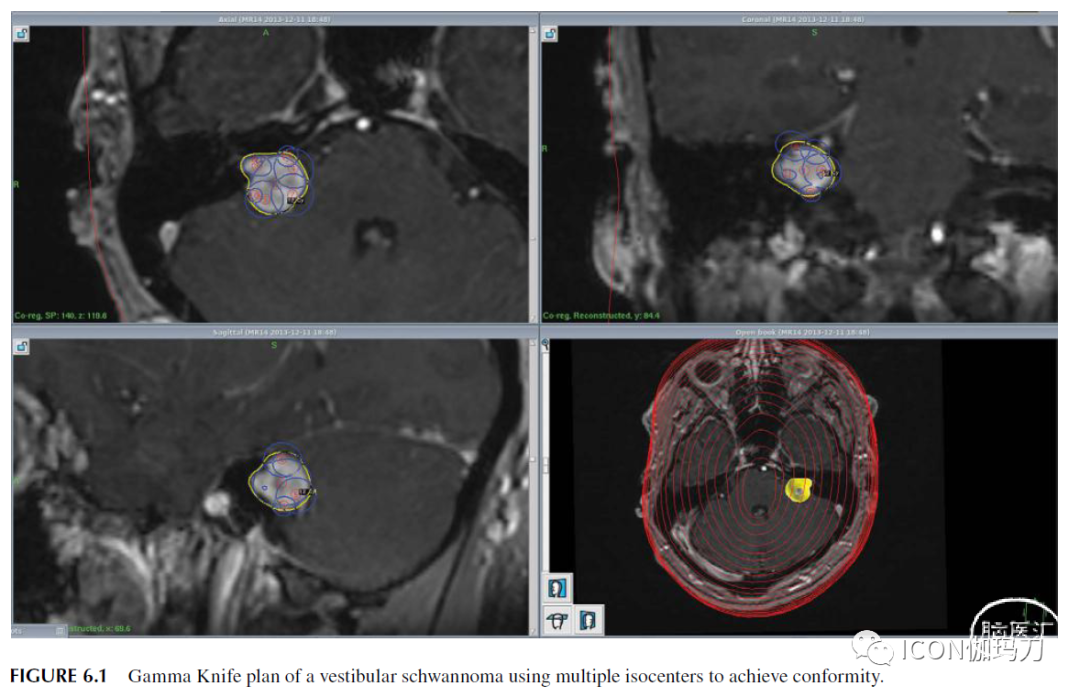
图6.1前庭神经鞘瘤的伽玛刀计划使用多个等中心以达到适形。
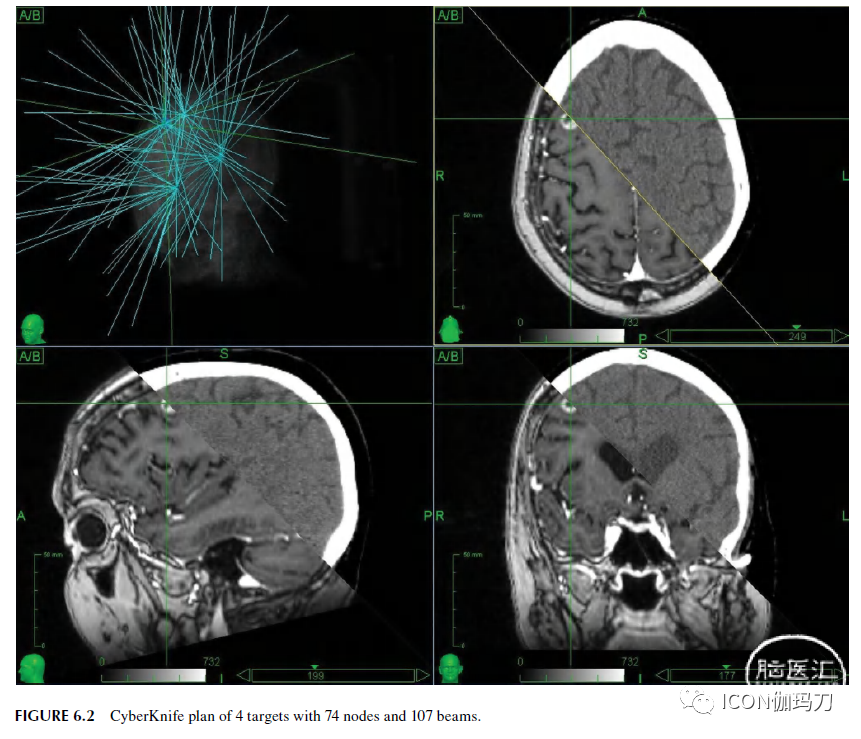
图6.2 用 74个节点和107条射线束照射4个靶区的射波刀方案。
6.5.2正向与逆向计划
在放射外科早期,治疗计划计算机还不够强大,无法进行多次迭代的自动优化( automated optimization with multiple iterations),颅内放射外科主要采用正向计划。在当代的实践中,特别是随着调强放疗的发展,逆向计划技术得到越来越多的应用。
在正向计划中,治疗计划者选择各种参数,如准直器的尺寸、等中心的数目和位置、射线束角度、拉弧角度、治疗床角度和射线束权重(In forward planning, treatment planners choose various parameters such as collimator size, number and location of isocenter, beam angle, arc angle, couch angle and beam weights. )。虽然有时会使用模板形式的先验知识,但正向计划技术在很大程度上依赖于计划人员的经验(While prior knowledge in the form of templates are sometimes used, forward planning techniques rely to a large extent on the experience of the planner.)。
在逆向计划中,首先由计划者为治疗靶区和正常结构就靶区的剂量学目标和对邻近正常组织(例如,危及器官,OAR)的约束加以设定。然后,计算机程序优化所有可变参数,以满足这些目标和约束[In inverse planning, dosimetric goals for the target and constraints for the adjacent normal tissue (e.g., Organs at risk, OAR) are first set by planners for both treatment target and normal structures. A computer program then optimizes all the variable parameters to meet these goals and constraints.]。对于专业的CyberKnife , Versa HD, Edge和tomotherapy设备,射线束参数组合的数量是巨大的,大多数情况下只能通过逆向技术来计划。虽然逆向计划技术已成为颅内放射外科治疗的重要技术,但仍有许多病例采用正向技术快速有效。
6.5.3射线束塑形和照射交付
伽玛刀在半个多世纪前发展起来,至今仍是放射外科治疗的一种流行方法。伽玛刀使用许多来自不同方向的交叉圆形射线束,在治疗靶区周围形成一个球形的高剂量区域(Gamma Knife uses many intersecting circular beamlets from different directions to create a spherical-shaped high dose region around the treatment target.)。直线加速器在放射外科治疗中最初应用使用锥形准直器来模拟伽玛刀射线束,这并不奇怪。计划是由正向技术生成的,通常带有预先定义的治疗床和射线束角度模板(Plans are generated by a forward technique, often with templates of predefined couch and beam angles.)。由Brainlab和Varian主导的下一步发展,利用多叶准直器(MLC)进行适形性拉弧照射技术。在该方法中,MLC连续成形,以匹配靶区在所有照射拉弧角度下的射线束-眼部形状。适形拉弧技术相对于圆锥技术的一个优点是它能更有效地照射到非球形靶区。适形拉弧仍然是一个正向计划的过程,需要人工选择拉弧和调整权重。在具有挑战性的情况下,需要调整剂量以避开附近的关键结构,调强放疗技术经常被用来逆向优化射线束,以在靶区产生高剂量,同时保持关键重要结构受照的剂量在可耐受范围内。调强放射治疗技术采用多束固定光束,避免了从任何单个龙门角度照射烧蚀剂量。体积调制电弧疗法(VMAT)的下一步发展是将逆向调强放疗(IMRT)和拉弧输送技术相结合。与适形拉弧方法相相似,VMAT通过在几个拉弧内传递剂量,将小剂量分数到更大的区域。与适形拉弧不同的是,VMAT可以通过调节MLC形状、龙门旋转速度、剂量率来逆向优化方案以避开关键结构。
VMAT的另一个优点是能够用一个等中心和多个非共面拉弧治疗多个靶区,被称为单等中心治疗多靶区(Single Isocenter for Multiple Targets,SIMT)。图6.3。近年来,SIMT在基于LINAC的SRS/SBRT,尤其是颅内SRS,中越来越受欢迎。治疗计划通常由2 - 4个非共面调强拉弧来优化和提供照射。SIMT技术的计划质量与常规的每个靶区单独等中心的方法相似,通过适形性指数、梯度指数和全脑受照剂量来评价。有几种计划技术是有用的,下巴跟踪,准直器角度选择,最重要的是,在优化目标中限制正常的大脑平均受照剂量。SIMT通过同时照射多个靶区来缩短射线束照射时长(SIMT reduces the beam-on time by irradiating multiple targets simultaneously.)。这种共享的MU(机器跳数 monitor unit)特性,加上FFF模式的高剂量率和消除个体靶区之间的重复设置,与常规技术相比大大缩短了整体治疗时长。患者在治疗摆位上花费的时间更少,可以更舒适地保持相同的体位,从而减少了分割内运动的幅度。
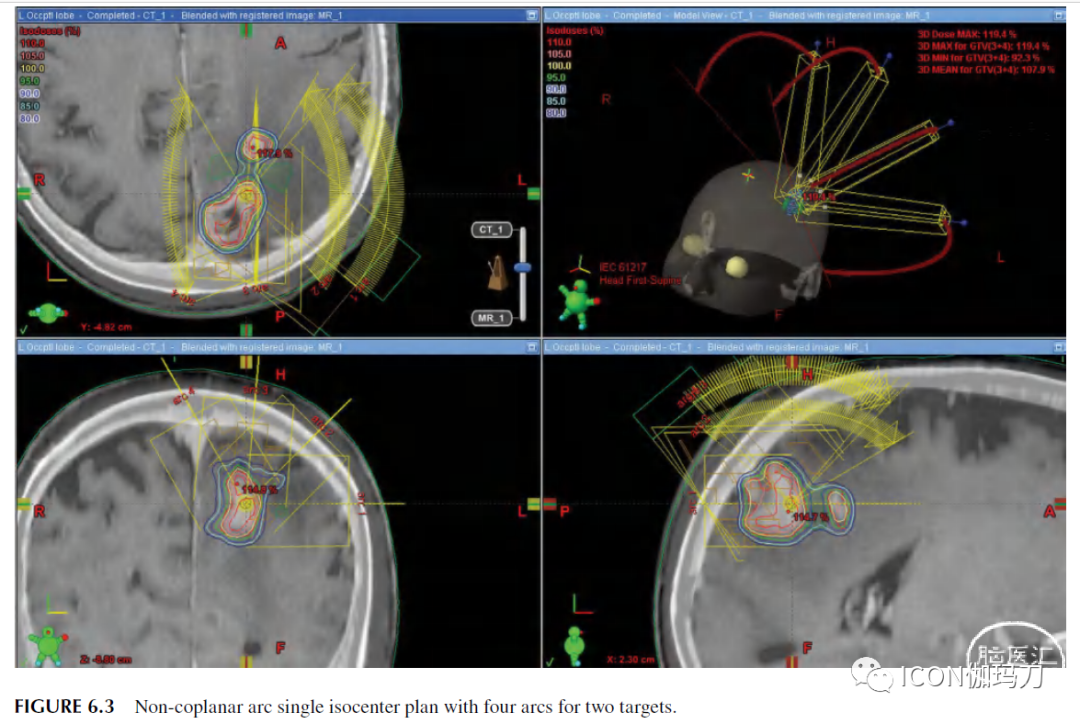
图6.3非共面拉弧单等中心平面,四个拉弧治疗两个靶区。
SIMT技术在颅外SBRT应用中还没有得到广泛的普及。与颅内靶区不同,它们通常不保持刚性的几何关系,这将导致某些靶区严重剂量不足。研究人员提出了具有独特优化的单等中心技术,即所有野共享一个共同的等中心,而每个野只治疗一个靶区。通过治疗野之间的治疗床平移,可以减轻旋转和变形的影响。然而,SIMT技术对颅外应用具有挑战性。最近开发的生物引导放疗机器为更有效地治疗这些颅外靶点打开了大门。
6.5.4 边缘扩展和有关边缘扩展假设的问题
在大多数放射治疗中,通常会在临床靶体积(CTV)中加入PTV边缘扩展,以考虑设置的不确定性。对于颅内放射外科方案,PTV切缘扩展通常被认为是零。这可能是因为在过去的所有颅内放射外科治疗中,总是使用头架侵袭性地将颅骨固定在治疗床上。与身体的其他部位不同,大脑不受明显的内部运动影响;因此,病变在治疗过程中固定在空间内。然而,需要考虑几个可能违反零PTV边缘扩展假设的问题。
首先,多模态图像配准产生的误差可以传播到靶区轮廓的不确定性。大多数颅内靶区是在功能性图像数据集(如磁共振成像(MRI))上勾画的,然后注册到定位的计算机断层扫描(CT)数据集。两组配准图像之间的任何不匹配都会导致靶区轮廓的不确定性。第二,放射外科治疗过程中的分割内运动导致靶区的不确定性。由于近年来图像引导技术的进步,无框固定在颅内放射外科治疗中越来越普遍。这种无框方法利用了侵袭性较小的面罩,并提供了一种替代常规的基于框架的方法,即将定位框架螺钉固定在患者的头骨中。尽管无框方法更方便、更舒适,但在治疗过程中,患者可以在固定面罩内移动2mm,这造成了额外的不确定性。第三,在治疗照射和图像引导系统的两个等中心之间留有有意义(non-trivial discrepancy)的差异,这个差异属于亚毫米量级(is on the order of a submillimeter)。第四,在个体患者治疗照射前,将设置验证图像配准到治疗定位图像,并且不考虑任何配准错配(setup verification images are registered to treatment planning image set before treatment delivery on individual patient, and any registration mismatch is not accounted for.)。最后,且并非最不重要的是,可能的亚临床疾病和肿瘤细胞可能位于影像对比增强所定义的病变之外(possible subclinical disease and tumor cells may lie outside of the lesion as defined by imaging contrast. )。这种不确定性可以说是指从肿瘤大体总体积(GTV)到肿瘤临床体积(CTV)的差距[This uncertainty is arguably the margin from gross tumor volume (GTV) to CTV],有些医生通过故意将处方等剂量线放置在可看到的肿瘤外几毫米处,间接地解释了这一点(some physicians account for this indirectly by intentionally placing the prescription isodose line several millimeters beyond the visual tumor.)。
所有这些假设都应该被描述为开展颅内放射外科治疗方案的特征,并且端间测试可以通过用体模模拟整个过程来评估整体几何的不确定性(All these assumptions should be characterized to start an intracranial radiosurgery program and anend-to-end test can evaluate the overall geometric uncertainties by simulating the whole process with a phantom.)。
6.5.5剂量不均匀性和适形性
与其他放疗计划类似,颅内放射外科治疗计划中,剂量不均匀性和适形性是两个相互竞争的指标。
不均匀性用最大剂量与处方剂量的百分比来评价(Inhomogeneity is evaluated as the percentage of maximum dose to the prescription dose.)。最大剂量的位置被称为“热点”,应该发生在治疗靶区内部(The location of maximum dose is called a “hot spot” and should occur inside the treatment target.)。
适形性衡量处方等剂量面与靶区轮廓的匹配程度(Conformity measures how well the prescription isodose surface matches the target outline.)。一个常见的适形性度量被定义为两个比率的乘积(A common conformity metric is defined as the product of two ratios)。一种测量处方等剂量外溢进入正常组织的量,定义为处方等剂量体积所包含的靶体积与处方等剂量体积的比值(One measures the amount of prescription isodose spillover into normal tissue—defined as the ratio of target volume encompassed by the prescription isodose volume to the prescription isodose volume)。其他测量的是有多少靶区未被处方等剂量所覆盖,即处方等剂量体积所包含的靶体积与靶体积的比值(The other measures how much target is not covered by the prescription isodose—defined as the ratio of target volume encompassed by the prescription isodose volume to the target volume.)。
适形性度量范围从0到1,其中1为最佳情况。如图6.4所示,为了避免不规则靶区出现冷点,增加了一个5毫米的锥体。由于等剂量云团与两个锥状体重叠,这一平面将比单一等中心平面产生更高的热点(an additional 5-mm cone was used to avoid a cold spot at the corner of this irregular shaped target. Because the isodose clouds overlap from the two cones, this plan will generate a higher hot spot than a single isocenter plan.)。在这种情况下,适形性是以牺牲不均匀性为代价的(conformity is achieved in the sacrifice of inhomogeneity)。
剂量的不均匀性和适形性随照射方式的不同而不同,是处方等剂量面的函数(Dose inhomogeneity and conformity varies greatly with delivery approach and are a function of prescription isodose surface.)。例如,在动态适形拉弧照射方法中,Hazard及其同事提出了一种选择处方等剂量面的统一方法,以平衡靶区覆盖率和适形性(proposed a uniform method to choose a prescription isodose surface to balance target coverage and conformity for dynamic conformal arc delivery approach)。
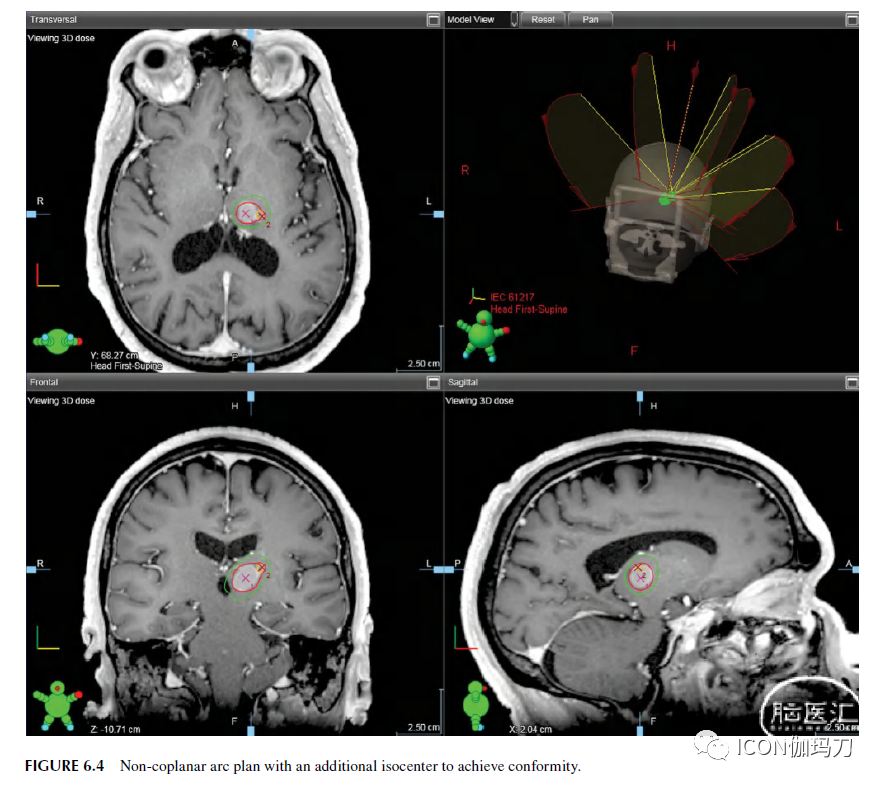
图6.4非共面拉弧计划,增加等中心以达到适形性。
6.5.6 多模态图像配准
剂量计算和图像引导通常需要一个主要的CT图像数据集,但颅内放射外科治疗的靶区往往不能很容易地在CT数据集上可视化。多模态图像配准需要在主要的CT数据集上勾画映射的靶区(Multimodality image registration is required to map the target delineation onto the primary CT dataset. )。这些模式包括MRI,正电子发射断层扫描(PET),质子磁共振波谱成像和单光子发射计算机断层扫描(SPECT)。磁共振图像畸变需要对几何不确定度进行量化和校正(The geometric uncertainty should be quantified and corrected for MR image distortion.)。系统固有畸变是由主磁场的不均匀性和非线性场梯度引起的(Inherent system distortion is caused by inhomogeneities in the main magnetic field and non-linearity of gradient fields.)。这种系统畸变随着离磁体中心的距离增加而增加,并且可以通过使用体模来校正(Such system distortion increases with distance from the magnet center, and it can be corrected by the use of phantoms)。然而,主要是由于对高磁场的担忧患者相关的畸变不容易被纠正(related distortions cannot be easily corrected, which is mainly a concern for high magnetic field)。
6.6图像引导
常规的颅内放射外科治疗程序利用有创框架和定位框来固定患者和对准靶区进行治疗。影像引导的进步已经成为放射外科最有价值的贡献之一。图像引导促进无创无框架固定的应用,从而实现了多次分割治疗,以及模拟和治疗照射的灵活性。除了患者让患者便利和微创手术的益处外,图像引导在消融性高剂量照射前或过程中提供了治疗靶区或颅骨替代的直接可视化(In addition to these benefits of patient convenience and a less invasive procedure, image guidance has provided direct visualization of the treatment target or skull surrogate before or during the ablative high-dose delivery)。当然,所有这些优势都伴随着对患者额外的成像剂量,因为一些技术和相关的质量保证程序需要验证成像和治疗等中心的一致性( all of these advantages come with an additional imaging dose to patients for some techniques and associated quality assurance procedures required to verify the coincidence of the imaging and treatment isocenters)。常见的图像引导技术包括立体二维(2D)X射线、CBCT、红外或光学引导和MR引导。它们既可用于治疗照射前的摆位引导,也可用于治疗期间的分割内引导(They can be used either for setup guidance before treatment delivery or for intra-fractional guidance during treatment.)。
6.6.1立体二维(2D)X射线
在该技术中,首先从定位CT数据集生成一组数字重建X线片( digital reconstructed radiographs,DRRs)。然后将患者摆在治疗位置,以斜交或正交的角度获得两个平面X线图像(Two planar X-ray images are then acquired at an oblique or orthogonal angle with patients at the treatment position)。接着,将X线图像配准到DRR上,计算图像引导偏移。这种技术包括治疗室安装和机架安装成像系统(room-mounted and gantry-mounted imaging systems. )。在治疗室安装装置中,千伏X线球管和数字探测板相对安装在天花板和地板上,成像射线束斜穿过靶区。采用该技术的典型商业系统是Novalis和CyberKnife。对于机架系统,千伏(kV )X线球管和检测板安装在与机架治疗射线束正交的位置。在两机架角上可正交获得两个千伏(kV)图像,用于图像引导( Two kV images can be acquired orthogonally at two gantry angles for image guidance.)。另一种替代技术是在不需要旋转机架的情况下,利用直线加速器的机架成像系统获得单个千伏图像和兆电压(MV)图像[An alternative technique is to acquire a single kV image and a megavoltage (MV) images using the linac s portal imaging system without the need of rotating gantry.]。机架安装系统可用于大多数现代直线加速器。安装在房间里的装置将图像引导系统的硬件组件与治疗照射系统分开。相关的优势包括更稳定的成像等中心,不受机架位置的变化,与机架安装系统相比,有较短的成像时间。治疗室安装的系统除了用于治疗前的摆位引导,也可以用于治疗照射期间的分割内引导。另一方面,机架式系统可以在任何角度对靶区进行成像,而不需要担心在某个特定角度机架会对遮挡图像(On the other hand, gantry-mounted system can image the target at any angle without the concerns that the gantry blocks images at certain angles.)。
6.6.2 体积三维(3D)X线成像
另一种流行的方法是使用体积三维锥形束CT (CBCT)图像引导,CBCT是由机架式千伏(kV)成像仪获得的许多投影重建而成。将CBCT图像集配准到定位CT数据集,以获得平移和旋转校正。与二维技术相比,体积三维成像可以显示轴位、矢状位和冠状位的解剖结构。当用一个等中心设置治疗多个靶区时,这个特性特别有吸引力。一个限制是使用CBCT对非共面射线束进行摆位引导,因为治疗床(或病人)和直线加速器机架之间可能发生物理碰撞(One limitation is the use of CBCT for setup guidance for non-coplanar beams because of potential physical collisions between the couch (or patient) and the linac gantry.)。体积三维技术的另一个主要限制是无法实现分割内引导,因为整个图像采集和重建过程大约需要1分钟,这对于实时引导来说太长了( Another major limitation of volumetric 3D technique is its inability for intra-fractional guidance because the whole process of image acquisition and reconstruction takes approximately 1 minute, which is too long for real-time guidance.)。由于治疗的高效率,对使用一个等中心和多个非共面拉弧来计划和治疗多个颅内靶区的兴趣越来越大。较短的治疗时间有利于患者的舒适和较少的靶区位置变化(The shorter treatment time is advantageous for patient comfort and associated less variation of target position.)。然而,未经纠正的治疗位置和计划位置之间的旋转差异可能会引入非微不足道的剂量误差(uncorrected rotational discrepancy between treatment and planning positions could introduce non-trivial dosimetric errors. )。例如,旋转偏差为1会导致距等中心10厘米处的位移为1.7毫米。这种位移可以将治疗靶区部分甚至完全移出治疗区域(uncorrected rotational discrepancy between treatment and planning positions could introduce non-trivial dosimetric errors. )。在这种情况下,一个机器人治疗床是必要的,以纠正安装旋转误差。当要求的旋转超出机器人治疗床的限制时,应该重复固定和摆位图像引导过程(When the required rotation is outside the limits of the robotic couch, the immobilization and setup image guidance process should be repeated. )。在治疗照射过程中,分割内引导应监测旋转和平移的变化(During treatment delivery, intra-fractional guidance should monitor both the rotational and translational changes.)。
6.6.3 红外和光学引导
X线图像引导技术暴露给患者额外的成像剂量,这不是微不足道的,特别是当用于局部引导时。红外和光学是解决这一问题的两种常用技术。红外技术使用安装在天花板上的摄像机来检测被动标记物或主动发光标记物的反射,标记物被放置在患者身上,它们可以作为靶区运动的合适替代。
红外引导技术可用于治疗前的初始摆位或分割引导(Infrared guidance techniques can be used for either initial setup prior to treatment delivery or intra-fractional guidance)。主要限制是标记物相对于患者颅骨的潜在运动(The major limitation is the potential movement of markers relative to the patient skull.)。在过去的几年里,光学引导技术已经出现在颅内放射外科的应用中。一些研究小组已经研究了使用商业化AlignRT系统开放式面罩固定的方法。在这种光学引导技术中,首先从定位CT数据集的皮肤呈现生成参考图像( In this optical guidance technique, a reference image is first generated from the skin rendering of the planning CT dataset.)。三个安装在天花板上的摄像头捕捉患者的面部特征,然后将它们与参考图像进行比较。这种光学引导技术的一个主要优点是能够监测治疗期间的任何运动,而无需额外的成像剂量(One major advantage of this optical guidance techniques is the ability of monitoring any movement during treatment delivery without additional imaging dose.)。此外,患者固定在不受限制的面罩下更舒适、依从性更好(patients are more comfortable and compliant under the less restrictive immobilization masks. )。光学引导技术通常被用作在基于X线技术摆位引导后的一种分割内引导方法( The optical guidance technique is typically used as an intra-fractional guidance method after setup guidance by an X-ray based technique. )。
一些问题可能会导致使用光学技术的定位误差,例如,它依赖于治疗室照明和感兴趣区域(ROI)的选择[its dependence on room lighting and region of interest (ROI) selection]。此外,当患者改变体重或服药时,会发生皮肤变形,导致治疗靶区和监测的面部之间的位置发生变化(skin deformations can occur when patients change weight or take medication, causing a shift between the positions of treatment target and monitored facial surface)。
6.6.4基于MR的引导
基于磁共振的图像引导系统是最近发展出来的,可能成为颅内放射外科的范式改变。首先如同引入集成MR/钴-60装置,最近的发展导致引入集成MR-直线加速器系统(First introduced as an integrated MR/cobalt-60 device, more recent developments have resulted in integrated MR-linac systems )。磁共振成像引导的优点包括无电离成像剂量、快速的三维体积数据采集和高软组织对比度(The advantages of MR image guidance include non-ionizing imaging dose, fast 3D volumetric data acquisition, and high soft-tissue contrast. )。它们可以提供治疗前和分割内引导的三维数据集,可以在许多平面上查看。基于MR的图像引导可以提供直接的靶区可视化,这是较,依赖将颅骨,皮肤或标记物作为替代的其他图像引导技术的主要优势。对于在颅内放射外科的应用,在大多数情况下MR图像已经用于治疗计划过程中的靶区勾画;因此,一种基于磁共振的技术提供了独特的相同的图像模式的引导。
6.7质量保证和安全性
在任何放射治疗过程中,患者和治疗团队的安全都是至关重要的问题,但SRS/SRT尤其如此。剂量很高,而分割的次数很少,这意味着在治疗过程中几乎没有纠正错误的空间,而常规放疗可以做到这一点(Doses are high and the number of fractions is small, meaning there is little or no room to correct for mistakes in treatment delivery as can be done in conventional radiotherapy)。现代治疗设备越来越依赖复杂的模拟成像、机载成像和传输内治疗监测技术,以确保正确的射线束传输(Modern treatment devices increasingly rely on complex simulation imaging, on-board imaging, and intra-delivery treatment monitoring techniques to ensure correct beam delivery.)。用于SRS的某些设备(伽玛刀就是一个突出的例子)依赖于放射性物质(radioactive material ,RAM)作为能源,因此需要对RAM进行特殊的照顾和监护。强有力的质量保证、风险管理和培训制度对于放射外科项目的安全有效操作至关重要(A robust quality assurance, risk management, and training regime are essential to the safe and effective operation of a radiosurgery program.)。
6.7.1 SRS/ SRT的质量保证
来自国家和国际组织的大量已发表的研究和报告概述了射线束输送装置、治疗室内成像设备、多叶光栅(MLCs)、治疗计划系统和二次剂量学检查软件一般方面的调试和质量保证的最佳实践。作者建议读者参考这些报告,以获得SRS/SRT治疗照射交付的这些方面的指导。质量保证程序的范围也开始超越标准化的、通用的程序,取而代之的是使用故障模式和影响分析( Failure Mode and Effect Analysis ,FMEA)和故障树形图分析(fault-tree analysis)等技术对程序中涉及的相对风险进行正式的、基于风险的分析。SRS/SRT提供的高剂量,加上陡峭的剂量梯度,为靶区精度创造了极其激进的公差要求(The high doses delivered with SRS/SRT combined with the sharp dose gradients create a requirement for extremely aggressive tolerances for targeting accuracy.)。
即使离预期靶区有很小的偏差,肿瘤控制概率也会发生显著的变化(Even small deviations from the intended target can cause significant changes in tumor control probability.)。例如,Treuer等人研究了20例动静脉畸形患者和20例脑转移瘤患者的队列,观察靶区偏差对预测闭塞/肿瘤控制和正常组织并发症概率的影响( looking at the effect of target point deviations on predicted obliteration/tumor control and normal tissue complication probability)。他们发现,1.3 mm的偏差会使闭塞率/局部控制率降低约5%,这表明需要扩大治疗边缘[114]。然而,如前所述,在SRS/SRT的设置中往往不应用PTV边缘扩展(indicate a need for expanded treatment margins)。此外,在SRS/SRT的设置中,常规放疗中常用的边缘扩展公式所依据的少数射线束和许多分数割的假设也被违背(the assumptions of a small number of beams and a large number of fractions that underlie common margin formulas used in traditional radiotherapy are violated in the setting of SRS/SRT)。在治疗中,边缘扩展会增加照射组织的体积,而这些额外的体积本身可能会导致并发症发生率的增加(Margins inherently increase the volume of tissue irradiated in a treatment, and this extra volume may by itself contribute to an increase in complication rate. )。通过扩大治疗体积来补偿射线束流输送的不确定性的能力有限,而这强化了尽可能减少射线束输送不确定性的目标(The limited ability to compensate for beam delivery uncertainty by expanding treatment volumes reinforces the goal of minimizing beam delivery uncertainty as much as possible.)。AAPM TG-142建议基于作者的主观观察对放射治疗过程的各个部分采取一些干预水平,,即考虑到完整治疗的各个方面的总体不确定性,哪些才可能达到的效果( AAPM TG-142 suggests some action levels for various parts of the radiotherapy treatment process based on subjective observation of the authors regarding what is likely to be achievable given the overall uncertainties of various aspects of the complete treatment )。
6.7.2 Winston-Lutz测试和隐藏靶区/端到端测试
由于很早就认识到在设置SRS/SRBT时常规的直线加速器质量保证程序是不够的,因此制定了专门程序以确保程序的准确性。也许这些测试中最突出的是Winston-Lutz测试,该测试评估直线加速器的机械等中心和辐射等中心的一致性( assesses the coincidence of the mechanical and radiation isocenters of the linear accelerator)。
经典的Winston-Lutz测试包括在治疗机的假定等中心放置一个小球形靶区(通常使用治疗室激光)。在机器上设置一个合适的准直器(在SRS的情况下通常是一个圆形准直器),在靶球的下游垂直放置一个射线胶片。胶片曝光后,产生一个辐射点,叠加靶球的阴影(The classic Winston Lutz test involves placing a small spherical target at the presumed isocenter of the treatment machine (usually using the room lasers). A suitable collimator is set on the machine (often a circular collimator in the case of SRS) and a radiographic film is placed perpendicular to the collimator downstream of the target sphere. The film is exposed, resulting in a radiation spot with the superimposed shadow of the target sphere.)。靶区阴影中心与射野的中心之间的偏移量可以用来确定机械等中心和辐射等中心之间的差值(The offset between the center of the target shadow and the center of the field can be used to determine the difference between mechanical and radiation isocenter. )。在各种机架、工作台和准直器角度重复试验,以评估等中心符合的稳定性( The test is repeated at various gantry, table, and collimator angles to evaluate the stability of isocenter coincidence)。
随着时间的推移,Winston Lutz测试也随着技术的发展而不断改进。利用电子射野成像装置( electronic portal imaging devices,EPIDS)代替胶片作为检测器的方法已经发展。采用机载锥形束CT (CBCT)系统对准被测靶区,以测试机载成像系统与机械等中心和辐射等中心的重合情况。靶区也得到了发展,有了专门建造的 Winston-Lutz 体模,比原来的球形靶区建立起来更为直观( purpose-built Winston-Lutz phantoms available that are more intuitive to set up than the original spherical target)。
另一项相关但关键的QA技术是端到端测试(也称为隐藏靶区测试),尽管是在一个体模上,它试图评估从模拟到交付的全部治疗不确定性[A related, but critical QA technique is the end-to-end test (aka the hidden target test) that attempts to evaluate the complete treatment uncertainty from simulation through delivery, albeit on a phantom. ]。虽然细节可以采取多种形式,但测试包括一个嵌入靶区的体模,以及一个嵌入的检测器(通常是辐射变色胶片或辐射敏感凝胶)。在某些情况下,靶区和检测器被设计成在体模中独立可更换的插入物。嵌入靶区的体模,使用常规的临床成像协议进行成像,并以指定的剂量治疗靶区制定治疗计划(The phantom, with target embedded, is imaged using regular clinical imaging protocols, and a treatment plan is developed to treat the target to a specified dose. )。然后将体模安装在治疗机上并进行治疗。然后使用绝对剂量差或联合剂量/距离度量(如伽玛分析)将胶片或凝胶上捕获的最终剂量分布与原始计划进行比较[The phantom is then setup on the treatment machine and the treatment is delivered. The resulting dose distribution as captured on film or gel is then compared to the original plan using either absolute dose differences or a combined dose/distance metric such as gamma analysis]。
某些专门的SRS/SRT设备有相关的专门质量保证测试。例如,最新版本的伽玛刀使用一组可追踪的专门二极管检测器为治疗表创建校准补偿。用精确测量的参考伽玛刀对一组主二极管检测器进行校准。然后,这些主工具被用于为临床站点使用的特定位点二极管检测器创建校准补偿[ For example, the most recent version of the Gamma Knife uses a traceable set of specialized diode detectors to create calibration offsets for the treatment table. A set of master diode detectors are calibrated against a precisely-measured reference Gamma Knife. These master tools are then used to create calibration offsets for site-specific diode detectors that are used at clinical sites]。另一个例子是射波刀(CyberKnife),它使用等晶体来定义机械治疗室坐标系统。治疗室内x线系统上的等晶图像用于确定x线源/检测器对准校正[ uses an isocrystal to define the mechanical room coordinate system. Images of the isocrystal on the in-room X-ray system are used to determine the X-ray source/detector alignments]。
6.7.3单等中心多靶区(SIMTimt)技术的质量保证
旋转设置的不确定性对单等中心多靶区(SIMT)有较高的剂量影响。对于距离等中心较远的靶区,一个较小的旋转偏差会显著降低PTV的覆盖率,一些研究人员建议将靶区的等中心距离限制在4cm以内。已经开发了专用的体模来测试旋转的不确定性。在治疗前,应尽一切努力在初始对准时尽量减少旋转残留(Dedicated phantoms have been developed for testing the rotational uncertainties [123]. Every effort should be used to minimize the rotational residues at the initial alignment before treatments)。分割内跟踪在监测这种旋转偏差中起着关键作用。最常用的技术是采用成对的正交图像(orthogonal image pairs ),也采用MRI的表面成像引导 (surface imaging guidance)。
6.8 SRS / SRT方案的临床实施
临床实施SRS/SRT计划需要对治疗的适应症范围进行仔细的前期规划,需要实施该计划的临床和技术方面的工作人员,器械选择,认证标准,以及正在进行的SRS/SRT特定培训计划(Clinical implementation of an SRS/SRT program requires careful up-front planning of scope of indications to be treated, staff required to implement the clinical and technical aspects of the program, device selection, credentialing standards, and an ongoing program of SRS/SRT-specific training)。
在制定方案范围时,重要的考虑因素包括:治疗团队的临床和技术专长、机器上预期的患者负荷(以及该负荷是否在常规放疗负荷之上)、针对每种适应证的已发布的国家方案或其他临床指南的可用性。只有在机构伦理审查委员会的监督和批准下,才可以尝试偏离既定的临床标准(When developing the scope of the program, important considerations include the clinical and technical expertise of the treatment team, the expected patient load on the machine (and whether or not this load is on top of a traditional radiotherapy load), the and the availability of published national protocols or other clinical guidelines for treating each indication. Departures from established clinical standards should only be attempted with oversight and approval of the institutional review board.)。
SRS/SRT需要的工作流程和时间承诺不同,在许多情况下比常规的放射治疗所需的时间更大。人员和时间估计应该牢记这一点。可以利用各种来源来估计所需的人员编制水平。诸如AAPM、美国神经外科医师协会/神经外科医师大会(AANS/CNS)和美国放射肿瘤学会(ASTRO)等全国性专业组织已经发布了有助于评估的基准[SRS/SRT requires workflows and time commitments that differ, and are in many instances greater, than what is required for traditional radiation therapy treatments. Personnel and time estimates should bear this in mind. A variety of sources can be used to estimate required staffing levels. National professional organizations such as the AAPM, American Association of Neurological Surgeons/Congress of Neurological Surgeons (AANS/CNS), and American Society for Radiation Oncology (ASTRO) have published benchmarks that can aid in estimation]。
治疗机器的选择应该考虑医疗机构的放射肿瘤学和神经外科项目的整体范围。在许多情况下,放射肿瘤科内的现有的治疗设备将足以应付SRS/SRT治疗程序,很少或无需修改(Choice of treatment machine should take in consideration the overall scope of the radiation oncology and neurosurgery programs at the institution. In many cases, the existing treatment devices within the Radiation Oncology department will be sufficient for SRS/SRT procedures with little or no modification)。在其他情况下,一个专门的放射治疗设备,如伽玛刀或射波刀可能在临床和经济意义上是最好的。设备选择的关键问题是确保整个系统(从成像到交付)满足SRS/SRT对精度和准度的严格要求(The critical issue in equipment selection is to ensure that the system as a whole (from imaging through delivery) meets the strict requirements for accuracy and precision for SRS/SRT.)。
严格的认证标准和定期的SRS/ SRT特定培训是任何放射外科项目的另一个关键组成部分。在SRS设置中的几个错误管理可以直接追溯到治疗团队的一个或多个成员缺乏适当的培训。美国放射学会(ACR)和ASTRO为参与放射外科手术的神经外科医生、放射肿瘤科医生、医学物理师、放射计量学家和放射治疗师提供了定义和最低资格(provide definitions and minimum qualifications)。
此外,对于使用放射性材料的设备,美国核管理委员会和各协议国对从事放射外科手术的授权用户(放射肿瘤科医生)和授权医学物理师所需的经验、证书和培训有特定的监管要求[or devices that make use of radioactive materials, the US Nuclear Regulatory Commission and various Agreement States have specific regulatory requirements for experience, credentials, and training required for Authorized Users (radiation oncologists) and Authorized Medical Physicists performing radiosurgery.]。
由于SRS/SRT中不同的工作流程、靶区策略、处方剂量和专门的治疗设备,建议进行具体的培训(Because of the different workflows, targeting strategies, prescription doses, and specialized treatment devices used in SRS/SRT, specific training in recommended.)。
临床操作前的先期培训应包括供应商对用于SRS/SRT的设备的特定培训,以及在实施SRS/SRT方面具有丰富经验的中心进行观察。培训应包括所有参与治疗团队的人员,以覆盖整个程序的范围。
持续培训应包括审查临床操作程序,审查最近的管理失误和医疗事件报告,审查任何供应商报告的安全通知,模拟临床事故,以便演练应急反应程序(Ongoing training should include a review of clinical operational procedures, a review of recent reports of misadministrations and medical events, reviews of any vendor-reported safety notices, and simulations of clinical mishaps in order to rehearse emergency response procedures.)。

点击或扫描上方二维码,查看更多“脑肿瘤”内容